stable-worldmodel-a-high-performance-platform-for-reproducible-world-model-research
Ayush Chaurasia
Quentin Lhoest
Lucas Maes
Quentin Le Lidec
reproducible-data-curation-in-the-multimodal-lakehouse
Prashanth Rao
newsletter-may-2026
ChanChan Mao
newsletter-april-2026
ChanChan Mao
how-lancedb-accelerates-vector-search-at-10-billion-scale
Yang Cen
opensearch-vs-lancedb-for-vector-search-query-cost-and-infrastructure
Justin Miller
volcano-engine-autonomous-driving-data-lake-solution
Kejian Ju
unifying-the-av-ml-stack-lancedb
Ayush Chaurasia
lance-json-support-why-you-might-not-really-need-variant
Jack Ye
building-a-storage-format-for-the-next-era-of-biology
Pavan Ramkumar
newsletter-march-2026
ChanChan Mao
smart-parsing-meets-sharp-retrieval-combining-liteparse-and-lancedb
Clelia Astra Bertelli
Prashanth Rao
lance-format-v2-2-benchmarks-half-the-storage-none-of-the-slowdown
Xuanwo
make-your-sql-workflows-multimodal-with-lancedb-x-duckdb
Prashanth Rao
agentic-coding-as-community-stewardship
Xuanwo
what-we-mean-by-multimodal
Prashanth Rao
ai-native-development-local-continue-lancedb
Ty Dunn
lance-file-format-2-2-taming-complex-data
Xuanwo
lance-blob-v2
Xuanwo
Jack Ye
openclaw-lancedb-memory-layer
Xuanwo
Prashanth Rao
openclaw-lancedb-seed2
LanceDB
openclaw-memory-from-zero-to-lancedb-pro
Prashanth Rao
upload-lance-datasets-to-hf-hub
Prashanth Rao
zero-shot-image-classification-with-vector-search
Vipul Maheshwari
werides-data-platform-transformation-how-lancedb-fuels-model-development-velocity
Qian Zhu
Fei Chen
training-a-variational-autoencoder-from-scratch-with-the-lance-file-format
LanceDB
track-ai-trends-crewai-agents-rag
LanceDB
tokens-per-second-is-not-all-you-need
Mingran Wang
Tan Li
the-future-of-open-source-table-formats-iceberg-and-lance
Jack Ye
the-case-for-random-access-i-o
LanceDB
series-a-funding
Chang She
semanticdotart
Ayush Chaurasia
second-dinners-secret-weapon-lancedb-powered-rag-for-faster-smarter-game-development
Qian Zhu
search-within-an-image-331b54e4285e
Kaushal Choudhary
scalable-computer-vision-with-lancedb-voxel51-d8b65066d5f6
LanceDB
rethinking-table-file-paths-lance-multi-base-layout
Jack Ye
rag-isnt-one-size-fits-all
Leonard Marcq
python-package-to-convert-image-datasets-to-lance-type
Vipul Maheshwari
one-million-iops
Weston Pace
november-feature-roundup
Will Jones
newsletter-september-2025
Jasmine Wang
newsletter-october-2025
Jasmine Wang
newsletter-november-2025
ChanChan Mao
newsletter-june-2025
David Myriel
newsletter-july-2025
Jasmine Wang
newsletter-january-2026
ChanChan Mao
newsletter-february-2026
ChanChan Mao
newsletter-december-2025
ChanChan Mao
newsletter-august-2025
Jasmine Wang
my-summer-internship-experience-at-lancedb-2
Raunak Sinha
my-simd-is-faster-than-yours-fb2989bf25e7
LanceDB
multimodal-myntra-fashion-search-engine-using-lancedb
LanceDB
multimodal-lakehouse
David Myriel
multi-document-agentic-rag-a-walkthrough
Vipul Maheshwari
modified-rag-parent-document-bigger-chunk-retriever-62b3d1e79bc6
Mahesh Deshwal
memgpt-os-inspired-llms-that-manage-their-own-memory-793d6eed417e
Ayush Chaurasia
late-interaction-efficient-multi-modal-retrievers-need-more-than-just-a-vector-index
Ayush Chaurasia
lancedb-x-continue
LanceDB
lance-x-huggingface-a-new-era-of-sharing-multimodal-data
Prashanth Rao
Quentin Lhoest
Xuanwo
Ayush Chaurasia
lance-x-duckdb-sql-retrieval-on-the-multimodal-lakehouse-format
Xuanwo
lance-windows-windows-lance
Chang She
lance-v2
Weston Pace
lance-namespace-lancedb-and-ray
Jack Ye
lance-file-2-1-stable
Weston Pace
lance-file-2-1-smaller-and-simpler
Weston Pace
lance-data-viewer
Gordon Murray
lance-community-governance
Jack Ye
introducing-lance-namespace-spark-integration
Jack Ye
implementing-corrective-rag-in-the-easiest-way-2
LanceDB
hybrid-search-rag-for-real-life-production-grade-applications-e1e727b3965a
Mahesh Deshwal
hybrid-search-combining-bm25-and-semantic-search-for-better-results-with-lan-1358038fe7e6
LanceDB
hybrid-search-and-custom-reranking-with-lancedb-4c10a6a3447e
LanceDB
how-to-reduce-hallucinations-from-llm-powered-agents-using-long-term-memory-72f262c3cc1f
Tevin Wang
guide-to-use-contextual-retrieval-and-prompt-caching-with-lancedb
LanceDB
grpo-understanding-and-fine-tuning-the-next-gen-reasoning-model-2
Mahesh Deshwal
graphrag-hierarchical-approach-to-retrieval-augmented-generation
Akash Desai
gpu-accelerated-indexing-in-lancedb-27558fa7eee5
LanceDB
geo-support
Jack Ye
geneva-twelvelabs
David Myriel
geneva-feature-engineering
Jonathan Hsieh
from-bi-to-ai-lance-and-iceberg
Jack Ye
Prashanth Rao
fluss-integration
Wayne Wang
file-readers-in-depth-parallelism-without-row-groups
Weston Pace
feature-rabitq-quantization
David Myriel
Yang Cen
feature-full-text-search
David Myriel
enhance-rag-integrate-contextual-compression-and-filtering-for-precision-a29d4a810301
Kaushal Choudhary
effortlessly-loading-and-processing-images-with-lance-a-code-walkthrough
LanceDB
designing-a-table-format-for-ml-workloads
Weston Pace
custom-dataset-for-llm-training-using-lance
LanceDB
creating-a-fintech-agent
Vipul Maheshwari
convert-any-image-dataset-to-lance
LanceDB
columnar-file-readers-in-depth-structural-encoding
Weston Pace
columnar-file-readers-in-depth-repetition-definition-levels
Weston Pace
columnar-file-readers-in-depth-compression-transparency
Weston Pace
columnar-file-readers-in-depth-column-shredding
Weston Pace
columnar-file-readers-in-depth-backpressure
Weston Pace
columnar-file-readers-in-depth-apis-and-fusion
Weston Pace
chunking-techniques-with-langchain-and-llamaindex
Prashant Kumar
chunking-analysis-which-is-the-right-chunking-approach-for-your-language
Shresth Shukla
chat-with-csv-excel-using-lancedb
LanceDB
case-study-netflix
David Myriel
case-study-dosu
Qian Zhu
Michael Ludden
case-study-cognee
David Myriel
Vasilije Markovic
case-study-coderabbit
Qian Zhu
building-rag-on-codebases-part-2
Sankalp Shubham
building-rag-on-codebases-part-1
Sankalp Shubham
branching-and-shallow-clone
Jack Ye
better-rag-with-active-retrieval-augmented-generation-flare-3b66646e2a9f
LanceDB
benchmarking-random-access-in-lance
Chang She
benchmarking-lancedb-92b01032874a-2
LanceDB
benchmarking-cohere-reranker-with-lancedb
LanceDB
anythingllms-competitive-edge-lancedb-for-seamless-rag-and-agent-workflows
Ayush Chaurasia
announcing-lance-sdk
Weston Pace
agentic-rag-using-langgraph-building-a-simple-customer-support-autonomous-agent
LanceDB
advanced-rag-precise-zero-shot-dense-retrieval-with-hyde-0946c54dfdcb
LanceDB
accelerate-vector-search-applications-using-openvino-lancedb
LanceDB
a-primer-on-text-chunking-and-its-types-a420efc96a13
Prashant Kumar
a-practical-guide-to-training-custom-rerankers
Ayush Chaurasia
a-practical-guide-to-fine-tuning-embedding-models
Ayush Chaurasia
keep-your-data-fresh-with-cocoindex-and-lancedb
Prashanth Rao
Linghua Jin

Netflix's Media Data Lake and the Rise of the Multimodal Lakehouse

August 22, 2025
Case Study

Hollywood may run on storytelling, but behind every frame of a Netflix production lies another narrative written in data.

Every scene, audio track, subtitle, and script fragment is not just creative output. It is raw material for the next generation of machine learning. Petabytes of multimodal assets are spread across formats and workflows. Each one must be discoverable, queryable, and ready for research and training.

💡 The Media Data Lake

To meet this challenge, Netflix has introduced Media ML Data Engineering and built the Media Data Lake. This is a new specialization at Netflix that bridges the gap between traditional data engineering and the unique demands of media-centric machine learning.

The system unifies media assets, enriches them with metadata and embeddings, and serves them seamlessly into machine learning pipelines.

At the core of the platform sits LanceDB and the Multimodal Lakehouse.
multimodal-lakehouse

From Metrics Tables to Media Tables

Traditional pipelines were good at producing structured tables for metrics. Media data demands more. It is multimodal, unstructured, and deeply entangled with creative workflows. A single title may yield millions of frames, hours of multichannel audio, captions, embeddings, and annotations.

The nature of media data is fundamentally different. It is multi-modal, it contains derived fields from media, it is unstructured and massive in scale, and it is deeply intertwined with creative workflows and business asset lineage.
— Dao Mi and the Media ML Data Engineering team, Netflix Tech Blog

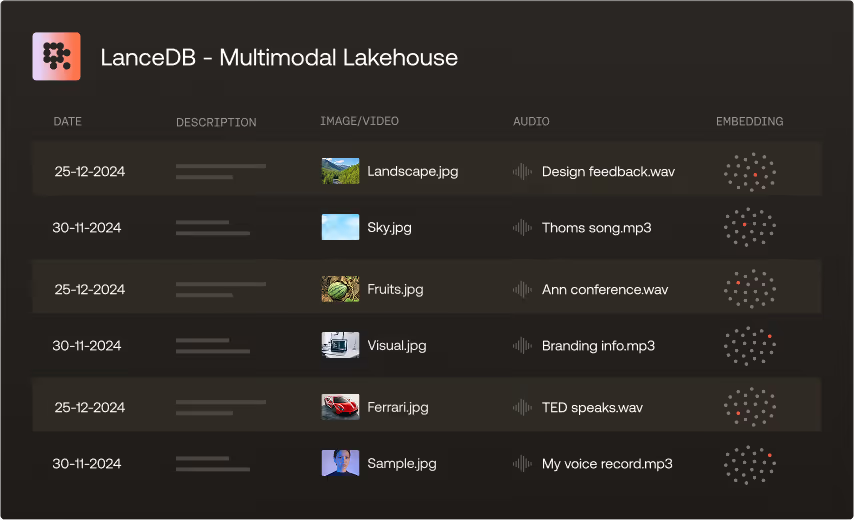
The Media Data Lake organizes this into Media Tables. These are structured but flexible datasets that contain both canonical metadata and the outputs of advanced machine learning models. With Lance as the underlying format, Netflix can evolve data and schema without costly rewrites. It can index embeddings alongside raw blobs. And it can query petabytes of content with low-latency, high-concurrency performance proven in production.

Figure 1: A sample media table used by the Netflix Engineering Team
multimodal-lakehouse

Architecture in Motion

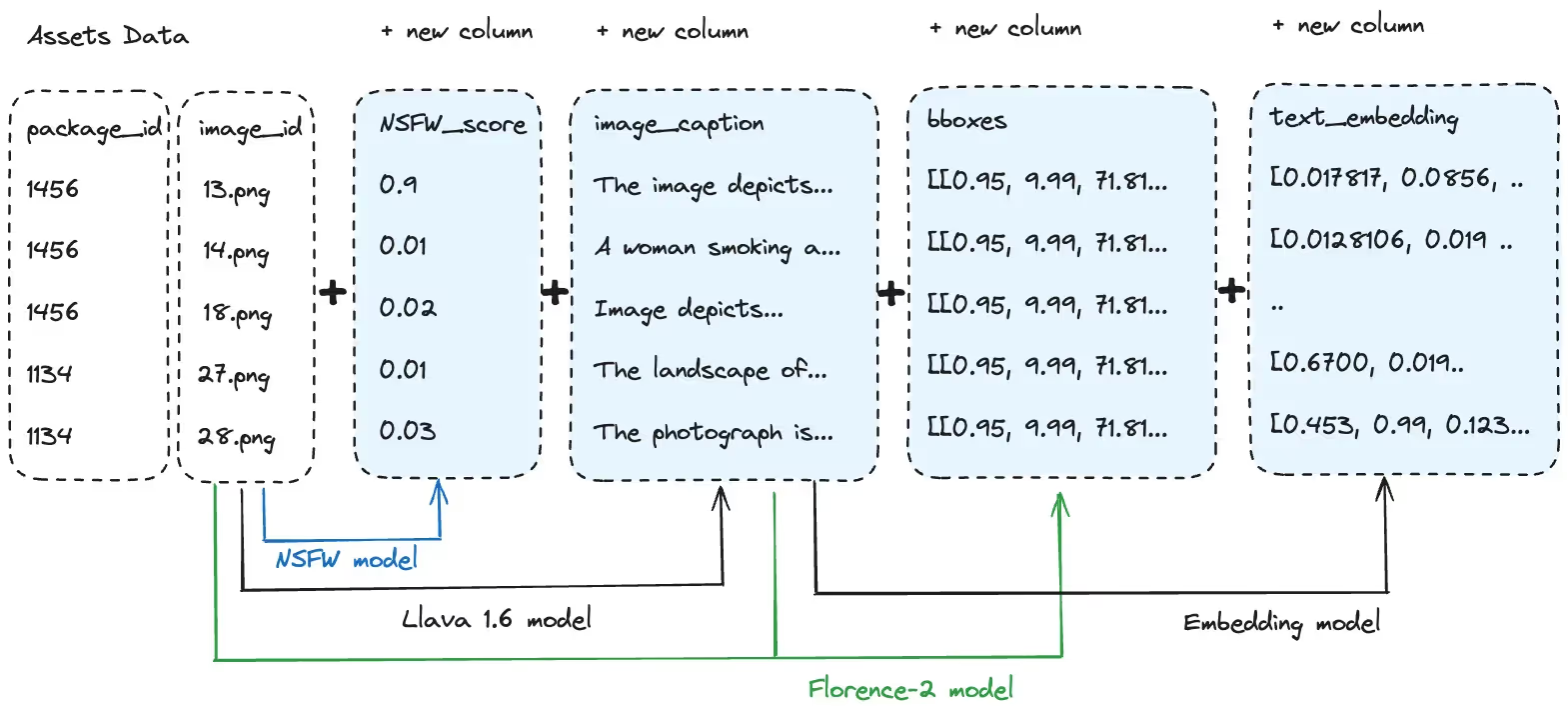
The architecture combines real-time and offline processing. Lightweight queries expose raw assets and derived features for exploration. A distributed inference layer executes GPU-powered batch jobs over entire libraries. A pythonic API provides programmatic access to the Media Tables. Visual interfaces allow interactive browsing of assets. This dual design enables both fast experimentation and reliable productionization. Traditional data lakes and warehouses were never built to support this balance.

Figure 2: Conceptual architecture of a Media Data Lake

graph LR classDef source fill:#e1f5fe,stroke:#333,stroke-width:1px,rx:6,ry:6 classDef lake fill:#c8e6c9,stroke:#333,stroke-width:1px,rx:6,ry:6 classDef table fill:#fff3e0,stroke:#333,stroke-width:1px,rx:6,ry:6 classDef access fill:#f3e5f5,stroke:#333,stroke-width:1px,rx:6,ry:6 classDef apps fill:#ffebee,stroke:#333,stroke-width:1px,rx:6,ry:6 A[Data Sources]:::source -->|ingest| B[Media Data Lake
LanceDB]:::lake B -->|organize| C[Media Tables
Metadata + Embeddings]:::table C -->|serve| D[API/UI Access]:::access D -->|train + search| E[ML Training +
Search Applications]:::apps

Figure 2 shows how Media Tables unify raw media, derived features, and machine learning outputs under one schema. This integration eliminates silos between creative assets and ML workflows, allowing researchers to query, explore, and train models on the same foundation. Built on LanceDB, it ensures that both interactive exploration and large-scale training run from a single source of truth.

Media Data Lake vs. Traditional Data Lakes

The table contrasts traditional data lakes with the Media Data Lake. Traditional systems handle structured data well but struggle with multimodal assets, schema and data evolution, and hybrid querying.

Feature Traditional Data Lake Media Data Lake (Netflix + LanceDB)
Data Types Structured tables (text, numeric) Multimodal (video, audio, images, text, embeddings)
Schema Rigid, costly to evolve Zero-copy data evolution
Query SQL only SQL, vector search, full-text search
Workload Batch analytics Real-time queries and GPU batch processing
Users Analysts, BI teams Machine learning engineers, researchers, creative ops

Where the Multimodal Lakehouse Shines

The Multimodal Lakehouse is built on LanceDB and the Lance format. It treats unstructured blobs as first-class citizens with uncompromised random access I/O. This is critical for shuffling and filtering media efficiently during training. Zero-copy data evolution means new features and annotations can be added without duplicating petabytes of data.

Hybrid querying combines vector search, full-text search, and SQL over the same table. This enables workflows like retrieving shots by visual similarity, filtering by dialogue, and joining against structured metadata. All of this happens in one unified system.

With LanceDB, blobs and embeddings are not afterthoughts. They are core building blocks in the data model.

On the compute side, declarative Python UDFs allow engineers to define feature extraction jobs that scale across hundreds of thousands of CPU cores and GPU slots.

This UDF will create an embeddings column directly from a text column. It uses a preloaded model to batch-encode sentences into fixed-length 384-dimensional vectors.

Features can be computed incrementally with checkpointing and preemption. Expensive GPU inference runs can pause and resume without wasted cycles. The system supports billions of vectors indexed in hours and tens of petabytes managed under a single abstraction.

💡 Production Tested

This performance has been proven in production by AI leaders such as ByteDance, MidJourney, Runway and Character AI.

Machine Learning Workflow Reimagined

Training pipelines also benefit directly. The Multimodal Lakehouse integrates with PyTorch and JAX loaders. Models can train on named SQL views over raw assets and features, with direct access to blob data through efficient APIs. A distributed cache fleet delivers more than five million IOPS from NVMe SSDs. It reduces cloud storage costs while sustaining more than twenty thousand QPS of vector search traffic. This allows Netflix to experiment with large multimodal models while maintaining production-grade cost efficiency.

One of the most exciting developments is the rise of media tables, structured datasets that not only capture traditional metadata, but also include the outputs of advanced ML models. — Netflix Tech Blog

This revolution is about transforming media into structured, queryable, reusable fuel for the next generation of machine learning. That fuel can power HDR remastering, localization quality metrics, narrative understanding, multimodal search, and future applications that have not yet been imagined.

A New Level of Collaboration

By anchoring its Media Data Lake on LanceDB, Netflix has created one of the first large-scale demonstrations of the Multimodal Lakehouse vision.

With LanceDB, developers, data scientists, ML researchers, and product engineers can work together seamlessly on building intelligent applications. By abstracting away the complexity of vector storage, indexing, and retrieval, LanceDB ensures data solutions are not only fit for purpose but also easy to extend.

Figure 3: Teams can collaborate around the Multimodal Lakehouse as a source of truth

flowchart LR %% Nodes DP1[Data Producer 1] DP2[Data Producer 2] DP3[Data Producer 3] MDE{{Media ML Data Lake}} AE[Analytics Engineer] DS[Data Scientist] RS[Research Scientist] %% Flows DP1 --> MDE DP2 --> MDE DP3 --> MDE MDE --> AE MDE --> DS MDE --> RS %% Styling classDef center fill:#f8c8c8,stroke:#e74c3c,stroke-width:2px,color:#000,rx:6,ry:6 classDef producers fill:#e3f2fd,stroke:#1976d2,stroke-width:2px,color:#000,rx:6,ry:6 classDef analytics fill:#f3e5f5,stroke:#7b1fa2,stroke-width:2px,color:#000,rx:6,ry:6 classDef dataScience fill:#e8f5e8,stroke:#388e3c,stroke-width:2px,color:#000,rx:6,ry:6 classDef research fill:#fff3e0,stroke:#f57c00,stroke-width:2px,color:#000,rx:6,ry:6 class MDE center class DP1,DP2,DP3 producers class AE analytics class DS dataScience class RS research

For Netflix, it means faster iteration cycles and richer insights into creative workflows. For the wider ecosystem, it signals the arrival of a new standard. One platform that unifies multimodal data, computation, and machine learning into a single, production-ready foundation.

Learn More About LanceDB

The foundation that powers Netflix's Media Data Lake is open source and available to everyone. LanceDB and the Lance format bring the same capabilities to any team working with multimodal data. With fast random access, zero-copy data evolution, hybrid search, and scalable feature engineering, LanceDB is redefining what a data lake can do in the age of AI.

💡 Technical White Paper

To learn more about the Multimodal Lakehouse, read our study Why Multimodal Data Needs a Better Lakehouse?

David Myriel
Writer, Software Engineer

Stable-Worldmodel: A High Performance Platform for Reproducible World Model Research

Ayush Chaurasia
Quentin Lhoest
Lucas Maes
Quentin Le Lidec
June 2, 2026
stable-worldmodel-a-high-performance-platform-for-reproducible-world-model-research

🌍 Lance-Backed World Model Platform, 🦆 Multimodal SQL with Lance DuckDB Extension, 💰 LanceDB vs OpenSearch Cost Breakdown

ChanChan Mao
May 28, 2026
newsletter-may-2026

Reproducible Data Curation In The Multimodal Lakehouse

Prashanth Rao
May 29, 2026
reproducible-data-curation-in-the-multimodal-lakehouse