

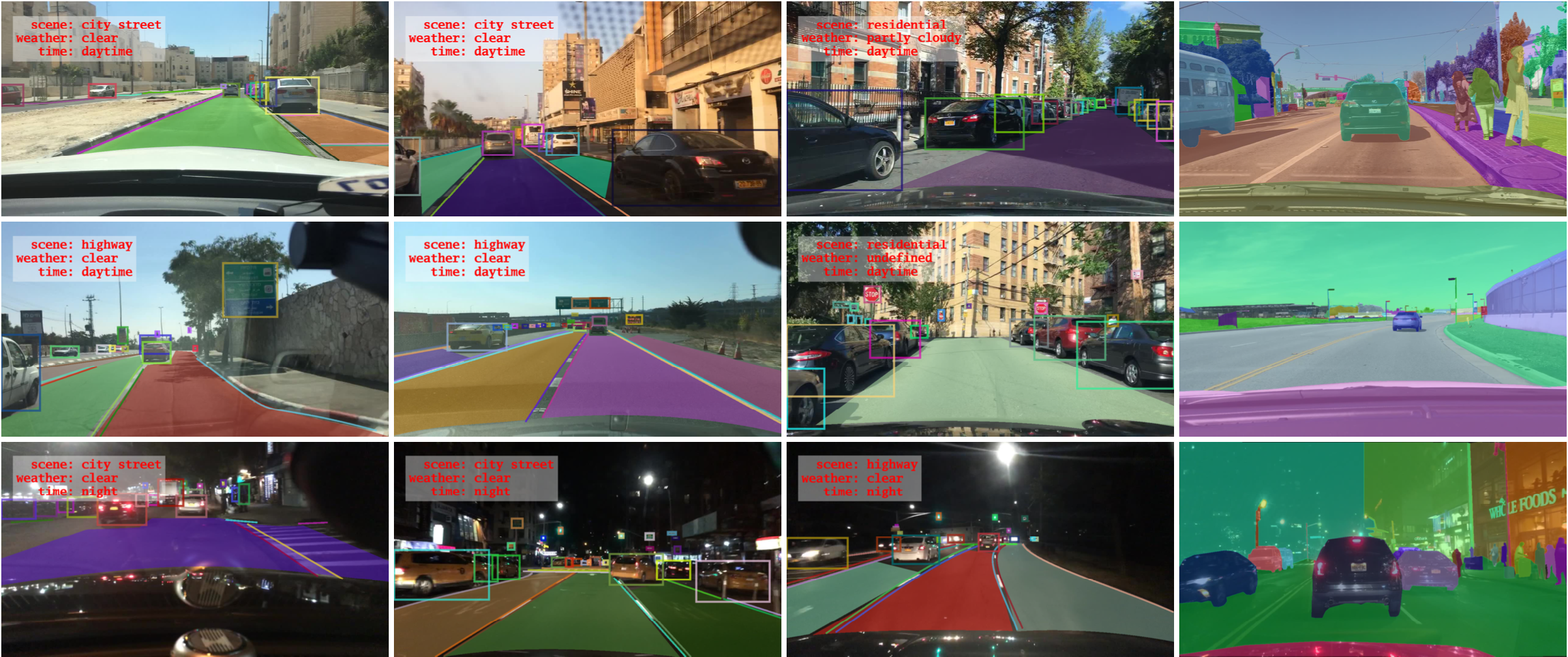
Your object detection model just failed a deployment test because it struggles on a few edge cases like pedestrians at a distance. You have frames from thousands of hours of dashcam footage sitting in object-storage. Getting the right frames into a clean training split and into your DataLoader will take the rest of the week.
It shouldn't have to be that way.
The bottleneck isn't compute. The bottleneck is everything that happens *between* training runs:
- Finding the right data, deriving the right features, deduplicating near-identical frames, creating reproducible splits, and doing it again when new footage arrives.
- In a conventional stack that consists of object store, annotation database, preprocessing scripts, feature store/VectorDB and CSV manifests, every one of those steps is a separate system with its own failure mode
- A new feature idea triggers a full dataset rewrite. A new data source triggers a migration. And when you finally make it to training, your H100 spends more time waiting on data than running matrix multiplications.
The core problem is that traditional ML data stacks were never designed for fast iteration on large-scale AI datasets. They were fine when you trained a model once a quarter, but not when you're trying to close failure-mode gaps on a weekly cadence, especially at petabyte-scale.
LanceDB is designed to address these bottlenecks at large scale. It is an AI-native multimodal lakehouse built on Lance, an open-source columnar format designed around ML access patterns. This post walks through a complete AV perception pipeline. Each stage uses the same LanceDB table and its features for ingestion, curation, evolution and training without any intermediate file format or hand-off between systems, allowing you to move from raw data to trained models in hours, not weeks.
The experiment setup

We'll use BAIR's BDD100K dataset as a smaller representation of real-world AV dashcam footage dataset. It involves curating three deployment-critical failure modes, deduplicating with vector search, and training Faster R-CNN (an object detection model), using LanceDB as the single data layer at every stage. The goal is to show what the iteration cycle looks like when the data layer is designed for it: new feature idea to query result in minutes, new footage to updated training split in four commands, checkpoint to reproducible data snapshot with a version number.
Autonomous vehicle perception models fail in predictable ways. For example, let's say your COCO-pretrained Faster R-CNN degrades on three deployment-critical scenarios that are underrepresented in standard benchmarks:
The fix is targeted fine-tuning on curated slices. But curating the right data across these three modes requires different signals from different places. In a conventional stack, those signals live in separate systems: annotation databases, metadata stores, preprocessing scripts.
LanceDB based workflow overview
┌─ Fleet footage (BDD100K, ~100k dashcam frames)
│
│                          │ Ingest
│                          ▼
│  ┌───────────────────────────────────────────────────────────┐
│  │                    bdd100k  [Lance table]                 │
│  │  image_bytes · weather · scene · timeofday · timestamp    │
│  │  ann_categories · ann_bboxes · ann_occluded · split       │
│  │  ┌──────────────────────────────────────────────────────┐ │
│  │  │  Blob storage     — fast reads, no object-store hop  │ │
│  │  │  Multimodal       — bytes + structs + vectors        │ │
│  │  │  Stable row IDs   — incremental view refresh         │ │
│  │  └──────────────────────────────────────────────────────┘ │
│  └───────────────────────────────────────────────────────────┘
│                          │
│                          │ backfill_geneva.py  (Geneva UDFs — incremental, checkpointed)
│                          │
│                          │  Tier 1 — CPU:  has_person · has_rider · scene_description
│                          │  Tier 2 — GPU:  person_bbox_area_pct  (Faster R-CNN)
│                          │               clip_embedding [512-d]  (CLIP ViT-B/32, IVF-PQ)
│                          │  Tier 3 — GPU:  dhash [64-bit]  (dHash) + IVF L2 → is_duplicate
│                          │
│                          │  ┌──────────────────────────────────────────────────────┐
│                          │  │  Zero-copy evolution  — new column, no table rewrite │
│                          │  │  Incremental backfill — only calculate for new rows  │
│                          │  │  Checkpointed         — crash-safe, restart mid-run  │
│                          │  │  Ray-distributed      — scales to thousands of nodes │
│                          │  └──────────────────────────────────────────────────────┘
│                          │
│                          │  EDA & curate
│                          │  ┌──────────────────────────────────────────────────────┐
│                          │  │  SQL         — columnar index, no JOIN, no export    │
│                          │  │  FTS         — BM25 on scene_description             │
│                          │  │  CLIP vector — text→image · image→image · discovery  │
│                          │  │  Hybrid      — CLIP + SQL pre-filter, single query   │
│                          │  └──────────────────────────────────────────────────────┘
│                          │
│                          │  (Materialized views)
│                          │  ┌─ Views ──────────────────────────────────────────────┐
│                          │  │  Living SQL queries — curation filter in one place   │
│                          │  │  Versioned refresh  — table.version links weights→data│
│                          │  └──────────────────────────────────────────────────────┘
│                          │
│              ┌───────────┼──────────────┐
│              ▼           ▼              ▼
│    bdd100k_rider  bdd100k_nighttime  bdd100k_distant
│    _{train,val}   _person_{t,v}      _person_{t,v}
│    [Materialized  [Materialized      [Materialized
│       view]          view]              view]
│              └───────────┼──────────────┘
│                          │
│                          │
│                          │  ┌─ Training ──────────────────────────────────────────┐
│                          │  │  Permutation API — random-access over Lance, no copy │
│                          │  │  PyTorch DataLoaders — direct from Lance tables      │
│                          │  │  High GPU utilization (MFU) — reads direct from Lance│
│                          │  └──────────────────────────────────────────────────────┘
│                          ▼
│               ┌──────────────────┐
│               │    Checkpoint    │  ← version = exact data snapshot
│               │ + table.version  │
│               └──────────┬───────┘
│                          │ new footage arrives
│               ┌──────────▼────────────────────────────────────┐
│               │  append → backfill (new rows only)             │
│               │  → refresh views → train again                 │
└───────────────┴───────────────────────────────────────────────┘
Sample results after training
*Green = ground truth · Red = COCO pretrained baseline · Blue = fine-tuned model*



2. Fine-tuned model makes no false predictions for the rider
3. Fine-tuned model is able to correctly detect distant people in the dark (extreme left) while base model can't
The Workflow Summarised
Native Multimodal support: 100k BDD100K frames land in a single Lance table with raw JPEG bytes, weather strings, annotation lists, and split labels all in one schema. That table is the only data artefact the rest of the pipeline reads from or writes to. No separate image store, no external vector database, no annotation database.
Zero-copy schema evolution: Derived signals like `has_person`, `has_rider`, `scene_description`, `person_bbox_area_pct`, `clip_embedding`, `dhash`, `is_duplicate` are added as new columns oare added as new columns on bdd100k without duplicating any existing data.
Feature engineering at scale: Each derived column is computed by a Geneva UDF, which is a Python function or class that Geneva distributes across workers, writing results back to LanceDB table. A crash at frame 70,000 of 80,000 resumes from the last checkpoint, not frame 0. GPU UDFs (`person_bbox_area_pct`, `clip_embedding`, `dhash`) load their model once per worker on first call and reuse it across every subsequent batch. The same UDF that runs on a laptop runs on a cluster of hundreds of machines with zero code changes.
Advanced retrieval and filters: SQL, BM25 full-text search, and vector search are all first-class index types on different columns of the same table. SQL filters by `timeofday`, `has_person`, `person_bbox_area_pct`. FTS on `scene_description` finds rare scenarios in natural language. The `clip_embedding` vector index enables text-to-image and image-to-image search for EDA
Materialized views: Training splits like `bdd100k_rider_train`, `bdd100k_nighttime_person_train`, `bdd100k_distant_person_train` are named LanceDB tables defined by a SQL WHERE clause, not CSV exports. When new footage arrives, `mv.refresh()` appends only rows that satisfy the filter. So this is incremental, nothing is rebuilt from scratch.
Built-in versioning Every `add()`, `backfill()`, and `refresh()` increments the table version. Training scripts log `table.version` alongside every checkpoint, a permanent link between weights and the exact data snapshot that produced them, with no external versioning system.
Permutation API and native PyTorch support Faster R-CNN trains directly against each materialized view via the Permutation API, a dataloading utility of LanceDB and reads go straight from the Lance file to GPU memory, allowing you to hit peak MFU in your training jobs. No copy, no intermediate format.
Detailed Walkthrough
Ingestion: structured multimodal table from unstructured data
The BDD100K dataset comes as separate zip file for each split of images, and each type of annotation in json files. Something like this:
bdd100k/
  ├── images/
  │   ├── 100k/
  │   │   ├── train/          # 70,000 JPEGs
  │   │   │   ├── 0000f77c-6257be58.jpg
  │   │   │   └── ... (70k files)
  │   │   ├── val/            # 10,000 JPEGs
  │   │   └── test/           # 20,000 JPEGs (no labels)
  │   ├── 10k/
  │   │   ├── train/          # subset for segmentation tasks
  │   └── seg/

  │
  ├── labels/
  │   ├── det_20/
  │   │   ├── det_train.json  # single JSON for all 70k train frames
  │   │   └── det_val.json    # single JSON for all 10k val frames
  │   ├── pan_seg/
  │   ├── sem_seg/
This is just a subset of labels. There's other type of task labels and video clips available in the dataset. With LanceDB, you can turn this unstructured, multi-folder dataset into a table with strict schema containing multimodal data blobs inline.
The full schema for the Lance table mixes types that would normally require separate storage systems:
BDD_SCHEMA = pa.schema([
    pa.field("image_bytes", pa.large_binary()),           # raw JPEG — Lance blob storage
    pa.field("weather",     pa.string()),
    pa.field("timeofday",   pa.string()),
    pa.field("ann_categories",  pa.list_(pa.string())),   # parallel lists per bbox
    pa.field("ann_bboxes",      pa.list_(pa.list_(pa.float32()))),
    # ... more annotation fields ...
])
LanceDB allows you to define schema both in PyArrow and Pydantic formats.
💡 LanceDB<>Hugging Face integration
You can upload any LanceDB dataset to Hugging Face to automatically enable rich table viewer and other HF-datasets native features, like streaming. Here's the link to the full enriched dataset artifact generated from this workflow, and uploaded to huggingface-hub

Feature Engineering: Geneva UDFs for data evolution
<TODO: Add geneva graphic from website>
The conventional approach to feature engineering has a structural problem, that it's not incremental. Every new feature requires running the whole script again. If it crashes at frame 70,000 of 80,000, you restart at frame 0.
With Geneva, you just define UDF is a Python function decorated with @udf. The backfill applies it to every row incrementally, writes results back to the Lance table as a new column, and checkpoints progress every N rows. The table evolves with new features, with 0-copy.
Here's are some UDFs that we used in this workflow:
Simple annotation-derived UDFs (CPU based, no image decoding):
Here's a couple examples of a very simple features, that create new features in the table based on the already existing annotation feature column
@udf(data_type=pa.bool_(), input_columns=["ann_categories"])
def has_person(ann_categories) -> bool:
    return "person" in list(ann_categories)

@udf(data_type=pa.string(), input_columns=["weather", "scene", "timeofday"])
def scene_description(weather, scene, timeofday) -> str:
    return f"{timeofday} {weather} scene on a {scene}"
GPU inference UDFs
When there's processing and setup required for a task like model loading etc. you can use batched and/or stateful UDFs. You can create a setup function in the class and invoke in __call__. It runs on workers and loads the model lazily on first invocation, then reuses it for every subsequent batch:
@udf(data_type=pa.float32(), input_columns=["image_bytes", "width", "height"], num_gpus=1, cuda=True)
class PersonBboxAreaPct:
    def __init__(self):
        self.model = None          # not loaded here — driver has no GPU

    def _load_model(self):
        self.model = load_detector().cuda()   # once per worker, reused across batches

    def __call__(self, image_bytes, width, height) -> pa.Array:
        if self.model is None:
            self._load_model()
        predictions = self.model(decode_images(image_bytes))
        return pa.array([bbox_area_pct(pred, w, h) for pred, w, h in zip(predictions, width, height)])
person_bbox_area_pct is the critical signal for the "distant pedestrian" failure mode: frames where a person annotation exists but occupies less than 20-30% of the frame are exactly the hard cases — distant, small figures the pretrained model is more likely to miss.
💡 UDF
For BDD100K, which ships with ground-truth boxes, this could be computed directly fromann_bboxesas a fast CPU UDF. The Faster-RCNN UDF models a production scenario: raw, unlabeled fleet footage where no ground truth exists and a detector is the only way to measure pedestrian prominence. The Geneva backfill pattern, UDF registered as a column, incrementally computed, immediately queryable as SQL is identical either way.
Running backfill
job_id = tbl.backfill(
    "person_bbox_area_pct",
    udf=PersonBboxAreaPct(),
    concurrency=4,        # parallel workers (1 per GPU for GPU UDFs)
    checkpoint_size=32,   # commit progress every N fragments — safe to interrupt
)
concurrency can scale from 1 on a laptop to hundreds on a KubeRay cluster. checkpoint_size is what makes the job crash-safe, a restart picks up from the last committed checkpoint, not frame 0.
After all backfills, every derived signal sits as a flat, queryable column alongside the original ingested fields. No joins, no manifests. We generate many features using geneva in this workflow, including the ResNet18 embeddings and is_duplicate flag which'll use in next section.
Curation: Explore and gather insights from large scale multimodal datasets
With LanceDB you can run SQL, FTS, and vector search on the same table, allowing you to explore and run analysis on massive tables without having to materialise everything in memory.
With all signals as new festures, the entire curation workflow is splitting dataset using SQL filters, which LanceDB supports natively:
# Total rows in train split - 80,000
tbl.count_rows(filter="timeofday = 'night' AND has_person = true")
# → 6,431 frames

tbl.count_rows(filter="has_person = true AND person_bbox_area_pct < 30.0")
# → ~3,200 frames where a person is annotated but occupies less than 30% of the frame
The scene_description column — generated by a Geneva UDF from the frame's weather, scene, and time-of-day attributes — gets an FTS index. Researchers can then iterate on rare-scenario queries in natural language without writing SQL predicates:
tbl.create_fts_index("scene_description")
tbl.search("rainy night pedestrian intersection", query_type="fts").limit(10).to_pandas()
Deduplication via vector search: Although BDD100K is dashcam footage dataset, it's highly curated and smaller in size, so it doesn't have many duplicates. But in real world there can be many duplicates in the dataset as consecutive frames within a clip are nearly identical pixels and training on them wastes compute and over-represents specific road segments. The dedup pipeline follows the exact same Geneva backfill pattern:
1. DHash UDF — backfill dhash: a 64-bit perceptual hash per frame, stored as a vector oftype list<float32>[64].
2. Build an IVF index on dhash.
3. is_duplicate UDF — backfill is_duplicate: for each row, find the nearest non-self neighbour via vector search; flag as duplicate if Hamming distance ≤ threshold (like 5,10).
# is_duplicate is now just a boolean column — filter it like anything else
tbl.count_rows(filter="has_rider = true AND split = 'train' AND is_duplicate = false")
The hash, the vector index, and the duplicate flag all live on bdd100k. The materialized views that follow automatically apply the dedup filter to training splits.
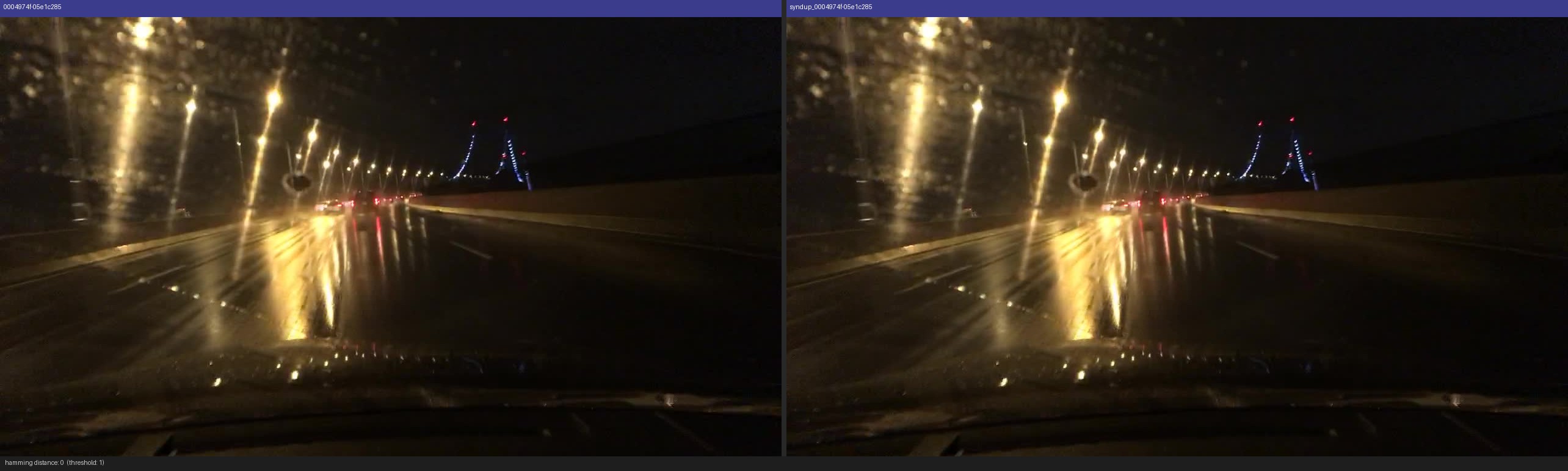
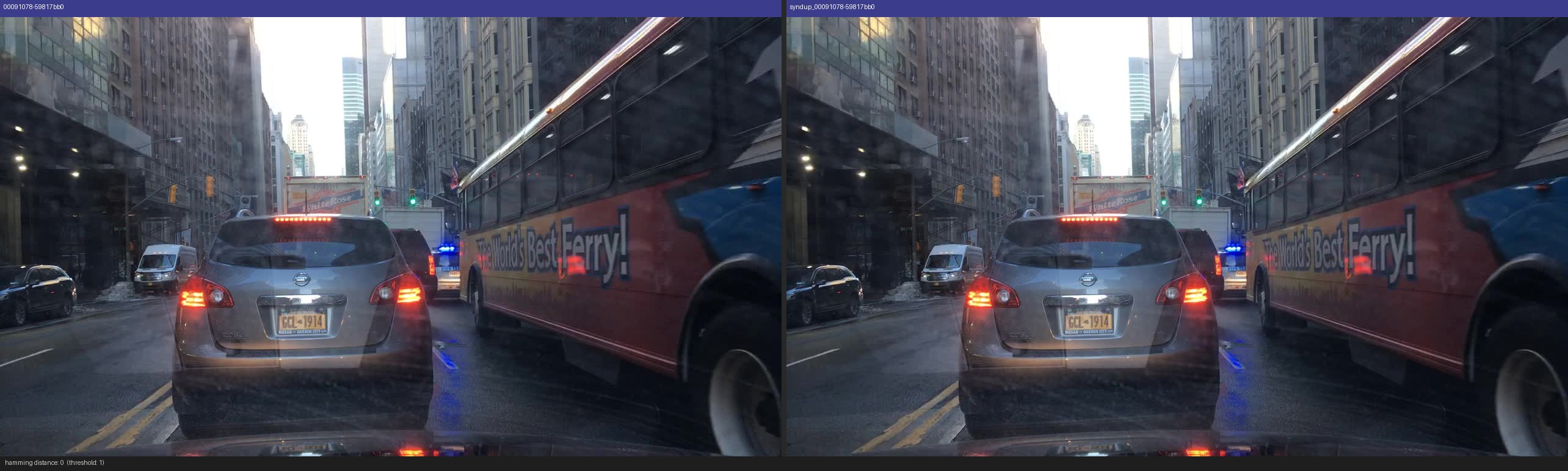
To validate the pipeline end-to-end, we append 1,000 exact-copy rows back into the table (new image_id, same image_bytes) and confirm that every injected row is flagged is_duplicate = true at Hamming distance 1 — a ground-truth test
Example duplicates plotted by the visualization helper from the project repo.
CLIP vector search for EDA: SQL and FTS work well when you know what you're looking for. But failure-mode discovery is inherently open-ended. You want to find frames you *can't* describe with a SQL predicate. That's where the `clip_embedding` column comes in: a 512-d embedding backfilled by a Geneva GPU UDF, with a cosine IVF-PQ index built after backfill. Because CLIP's image and text encoders share the same embedding space, every query that works as text also works as an image.
Text → Image : Retrieve frames matching a natural-language description. SQL can filter `timeofday = 'night'` but can't express "a small person barely visible in the distance." CLIP can.
vec = encode_text("a person far away walking on a dark road at night") # or other queries

tbl.search(vec, vector_column_name="clip_embedding").metric("cosine").limit(8).to_pandas()


Image → Image: Pick a query frame from the rider split and retrieve visually similar frames across the full table. Useful for finding cross-split near-duplicates or unlabeled frames from the same road segment.

Vector + SQL pre-filter: The same query with and without a SQL pre-filter shows the difference clearly. "Pedestrian crossing at an intersection" returns a mix of daytime and nighttime frames without a filter. Adding `timeofday = 'night'` restricts vector scoring to nighttime frames only. Neither SQL alone (no visual signal) nor CLIP alone (no metadata constraint) can do this.
tbl.search(vec, vector_column_name="clip_embedding")
	.where("timeofday = 'night'", prefilter=True)
	.metric("cosine").limit(8).to_pandas()
Discovery: unannotated edge cases: Find frames that CLIP scores as rider-like but have `has_rider = false`. These are candidates for missed annotations or genuine near-miss frames, exactly the kind of finding that's impossible to reach with SQL alone.
vec = encode_text("person riding a bicycle or motorcycle on the road")

tbl.search(vec, vector_column_name="clip_embedding")
	.where("has_rider = false AND has_person = true", prefilter=True)
	.metric("cosine")
  	.limit(8)
  	.to_pandas()

SQL, FTS, and vector search are not three different systems here. They're three different index types on different columns of the same Lance table, combined in a single WHERE clause.
Materialized Views: Training Splits That Refresh Themselves
With Materialized views, you define a transformation once and materialize it as a versioned table. When new data arrives, only the affected rows are processed.
A training split is a materialized view: a named Lance table defined by a some filtered view, commonly via a SQL clause. Creating one from a table is just 2 lines:
conn = geneva.connect("data/bdd100k/lancedb")
tbl  = conn.open_table("bdd100k")

query = tbl.search().where("has_rider = true AND split = 'train'")
mv    = conn.create_materialized_view("bdd100k_rider_train", query)
mv.refresh()

print(f"{mv.count_rows()} rows  (version {mv.version})") # 80,000 → 3,590 rows  (version 1)
The training script opens the view same as any other LanceDB table:
db  = lancedb.connect("data/bdd100k/lancedb")

tbl = db.open_table("bdd100k_rider_train")
When new footage is ingested and backfilled, one call per view incrementally adds only the new rows. For example, here's the refresh call after adding 500 rows to parent table:
mv = conn.open_table("bdd100k_rider_train")
mv.refresh() # [bdd100k_rider_train]  3,590 → 3,705 rows  (+115)  version 2
Given a checkpoint, you can always reproduce the exact data it was trained on by reopening the table at that version. No external versioning system needed.
Training: Load data from your multimodal lakehouse to PyTorch training loops without performance loss
Creating a PyTorch dataloader from a LanceDB dataloader is pretty straighforward. Open the materialized view, create a Permutation, hand it to torch DataLoader:
from torch.utils.data import DataLoader

db = lancedb.connect("data/bdd100k/lancedb")
tbl = db.open_table("bdd100k_rider_train")
perm = (    Permutation.identity(tbl)
			.select_columns(["image_bytes", "ann_categories", "ann_bboxes"]))

loader = DataLoader(perm, batch_size=64)
💡 DataLoader
Both LanceDB table & Permutation object can be used to create pytorchDataloader. But using a table Permutation is more flexible as it provides built in helpers to efficiently filter, shuffle, create splits etc.
LanceDB's on-disk layout provides fast random access at row level, allows faster iteration, with simple pure random shuffling faster than traditional data streaming setups like parquet-shards or webdataset. This keeps GPU utilization high even on loading multimodal datasets, allowing you to achieve close to theoretical peak GPU MFU of your workload.
Results
GPU runs on full BDD100K (80k frames), 10 epochs, A100, batch size 64, AMP enabled. Baseline is the COCO pretrained checkpoint evaluated on each curated val view.
Recall improvement dominates — the model catches significantly more of the objects it was previously missing. No external data was added; only the training distribution was corrected by curating the right slices from the existing dataset.
On New Data Arrival
What happens when hundreds of hours of new frames arrive next week?
ingest new footage → backfill increments only new rows → refresh all views → re-run training against updated views → checkpoint logs new table.versionNo manifest regeneration, pipeline rewrite, or team handoff. The view names don't change, the training command doesn't change. Only the version number increments, and the new checkpoint is linked to the new dataset/table version.
Code
The full implementation is in this repository. The README has step-by-step commands for each stage, and --synthetic 500 generates fake frames to verify the whole pipeline locally in minutes before committing to a full BDD100K download.