stable-worldmodel-a-high-performance-platform-for-reproducible-world-model-research
Ayush Chaurasia
Quentin Lhoest
Lucas Maes
Quentin Le Lidec
reproducible-data-curation-in-the-multimodal-lakehouse
Prashanth Rao
newsletter-may-2026
ChanChan Mao
newsletter-april-2026
ChanChan Mao
how-lancedb-accelerates-vector-search-at-10-billion-scale
Yang Cen
opensearch-vs-lancedb-for-vector-search-query-cost-and-infrastructure
Justin Miller
volcano-engine-autonomous-driving-data-lake-solution
Kejian Ju
unifying-the-av-ml-stack-lancedb
Ayush Chaurasia
lance-json-support-why-you-might-not-really-need-variant
Jack Ye
building-a-storage-format-for-the-next-era-of-biology
Pavan Ramkumar
newsletter-march-2026
ChanChan Mao
smart-parsing-meets-sharp-retrieval-combining-liteparse-and-lancedb
Clelia Astra Bertelli
Prashanth Rao
lance-format-v2-2-benchmarks-half-the-storage-none-of-the-slowdown
Xuanwo
make-your-sql-workflows-multimodal-with-lancedb-x-duckdb
Prashanth Rao
agentic-coding-as-community-stewardship
Xuanwo
what-we-mean-by-multimodal
Prashanth Rao
ai-native-development-local-continue-lancedb
Ty Dunn
lance-file-format-2-2-taming-complex-data
Xuanwo
lance-blob-v2
Xuanwo
Jack Ye
openclaw-lancedb-memory-layer
Xuanwo
Prashanth Rao
openclaw-lancedb-seed2
LanceDB
openclaw-memory-from-zero-to-lancedb-pro
Prashanth Rao
upload-lance-datasets-to-hf-hub
Prashanth Rao
zero-shot-image-classification-with-vector-search
Vipul Maheshwari
werides-data-platform-transformation-how-lancedb-fuels-model-development-velocity
Qian Zhu
Fei Chen
training-a-variational-autoencoder-from-scratch-with-the-lance-file-format
LanceDB
track-ai-trends-crewai-agents-rag
LanceDB
tokens-per-second-is-not-all-you-need
Mingran Wang
Tan Li
the-future-of-open-source-table-formats-iceberg-and-lance
Jack Ye
the-case-for-random-access-i-o
LanceDB
series-a-funding
Chang She
semanticdotart
Ayush Chaurasia
second-dinners-secret-weapon-lancedb-powered-rag-for-faster-smarter-game-development
Qian Zhu
search-within-an-image-331b54e4285e
Kaushal Choudhary
scalable-computer-vision-with-lancedb-voxel51-d8b65066d5f6
LanceDB
rethinking-table-file-paths-lance-multi-base-layout
Jack Ye
rag-isnt-one-size-fits-all
Leonard Marcq
python-package-to-convert-image-datasets-to-lance-type
Vipul Maheshwari
one-million-iops
Weston Pace
november-feature-roundup
Will Jones
newsletter-september-2025
Jasmine Wang
newsletter-october-2025
Jasmine Wang
newsletter-november-2025
ChanChan Mao
newsletter-june-2025
David Myriel
newsletter-july-2025
Jasmine Wang
newsletter-january-2026
ChanChan Mao
newsletter-february-2026
ChanChan Mao
newsletter-december-2025
ChanChan Mao
newsletter-august-2025
Jasmine Wang
my-summer-internship-experience-at-lancedb-2
Raunak Sinha
my-simd-is-faster-than-yours-fb2989bf25e7
LanceDB
multimodal-myntra-fashion-search-engine-using-lancedb
LanceDB
multimodal-lakehouse
David Myriel
multi-document-agentic-rag-a-walkthrough
Vipul Maheshwari
modified-rag-parent-document-bigger-chunk-retriever-62b3d1e79bc6
Mahesh Deshwal
memgpt-os-inspired-llms-that-manage-their-own-memory-793d6eed417e
Ayush Chaurasia
late-interaction-efficient-multi-modal-retrievers-need-more-than-just-a-vector-index
Ayush Chaurasia
lancedb-x-continue
LanceDB
lance-x-huggingface-a-new-era-of-sharing-multimodal-data
Prashanth Rao
Quentin Lhoest
Xuanwo
Ayush Chaurasia
lance-x-duckdb-sql-retrieval-on-the-multimodal-lakehouse-format
Xuanwo
lance-windows-windows-lance
Chang She
lance-v2
Weston Pace
lance-namespace-lancedb-and-ray
Jack Ye
lance-file-2-1-stable
Weston Pace
lance-file-2-1-smaller-and-simpler
Weston Pace
lance-data-viewer
Gordon Murray
lance-community-governance
Jack Ye
introducing-lance-namespace-spark-integration
Jack Ye
implementing-corrective-rag-in-the-easiest-way-2
LanceDB
hybrid-search-rag-for-real-life-production-grade-applications-e1e727b3965a
Mahesh Deshwal
hybrid-search-combining-bm25-and-semantic-search-for-better-results-with-lan-1358038fe7e6
LanceDB
hybrid-search-and-custom-reranking-with-lancedb-4c10a6a3447e
LanceDB
how-to-reduce-hallucinations-from-llm-powered-agents-using-long-term-memory-72f262c3cc1f
Tevin Wang
guide-to-use-contextual-retrieval-and-prompt-caching-with-lancedb
LanceDB
grpo-understanding-and-fine-tuning-the-next-gen-reasoning-model-2
Mahesh Deshwal
graphrag-hierarchical-approach-to-retrieval-augmented-generation
Akash Desai
gpu-accelerated-indexing-in-lancedb-27558fa7eee5
LanceDB
geo-support
Jack Ye
geneva-twelvelabs
David Myriel
geneva-feature-engineering
Jonathan Hsieh
from-bi-to-ai-lance-and-iceberg
Jack Ye
Prashanth Rao
fluss-integration
Wayne Wang
file-readers-in-depth-parallelism-without-row-groups
Weston Pace
feature-rabitq-quantization
David Myriel
Yang Cen
feature-full-text-search
David Myriel
enhance-rag-integrate-contextual-compression-and-filtering-for-precision-a29d4a810301
Kaushal Choudhary
effortlessly-loading-and-processing-images-with-lance-a-code-walkthrough
LanceDB
designing-a-table-format-for-ml-workloads
Weston Pace
custom-dataset-for-llm-training-using-lance
LanceDB
creating-a-fintech-agent
Vipul Maheshwari
convert-any-image-dataset-to-lance
LanceDB
columnar-file-readers-in-depth-structural-encoding
Weston Pace
columnar-file-readers-in-depth-repetition-definition-levels
Weston Pace
columnar-file-readers-in-depth-compression-transparency
Weston Pace
columnar-file-readers-in-depth-column-shredding
Weston Pace
columnar-file-readers-in-depth-backpressure
Weston Pace
columnar-file-readers-in-depth-apis-and-fusion
Weston Pace
chunking-techniques-with-langchain-and-llamaindex
Prashant Kumar
chunking-analysis-which-is-the-right-chunking-approach-for-your-language
Shresth Shukla
chat-with-csv-excel-using-lancedb
LanceDB
case-study-netflix
David Myriel
case-study-dosu
Qian Zhu
Michael Ludden
case-study-cognee
David Myriel
Vasilije Markovic
case-study-coderabbit
Qian Zhu
building-rag-on-codebases-part-2
Sankalp Shubham
building-rag-on-codebases-part-1
Sankalp Shubham
branching-and-shallow-clone
Jack Ye
better-rag-with-active-retrieval-augmented-generation-flare-3b66646e2a9f
LanceDB
benchmarking-random-access-in-lance
Chang She
benchmarking-lancedb-92b01032874a-2
LanceDB
benchmarking-cohere-reranker-with-lancedb
LanceDB
anythingllms-competitive-edge-lancedb-for-seamless-rag-and-agent-workflows
Ayush Chaurasia
announcing-lance-sdk
Weston Pace
agentic-rag-using-langgraph-building-a-simple-customer-support-autonomous-agent
LanceDB
advanced-rag-precise-zero-shot-dense-retrieval-with-hyde-0946c54dfdcb
LanceDB
accelerate-vector-search-applications-using-openvino-lancedb
LanceDB
a-primer-on-text-chunking-and-its-types-a420efc96a13
Prashant Kumar
a-practical-guide-to-training-custom-rerankers
Ayush Chaurasia
a-practical-guide-to-fine-tuning-embedding-models
Ayush Chaurasia
keep-your-data-fresh-with-cocoindex-and-lancedb
Prashanth Rao
Linghua Jin

Efficient RAG with Compression and Filtering

January 9, 2024
Engineering

Why Contextual Compressors and Filters?

RAG (Retrieval Augmented Generation) is a technique that helps add additional data sources to our existing LLM Models; however, in most cases, it also brings unnecessary data that is not relevant to the use case.

Compression and filtering are the techniques that can help us extract only the relevant data from the corpus, increasing the efficiency and speed of our application.

Contextual compression is self-explanatory, which means that it compresses the relevant (context) data from the large, raw dataset.

Filtering is a process that further cleans the data after compression from the large dataset. Both in sync can help us drastically reduce storage, retrieval, and cost of operation.

Working of Contextual Compression
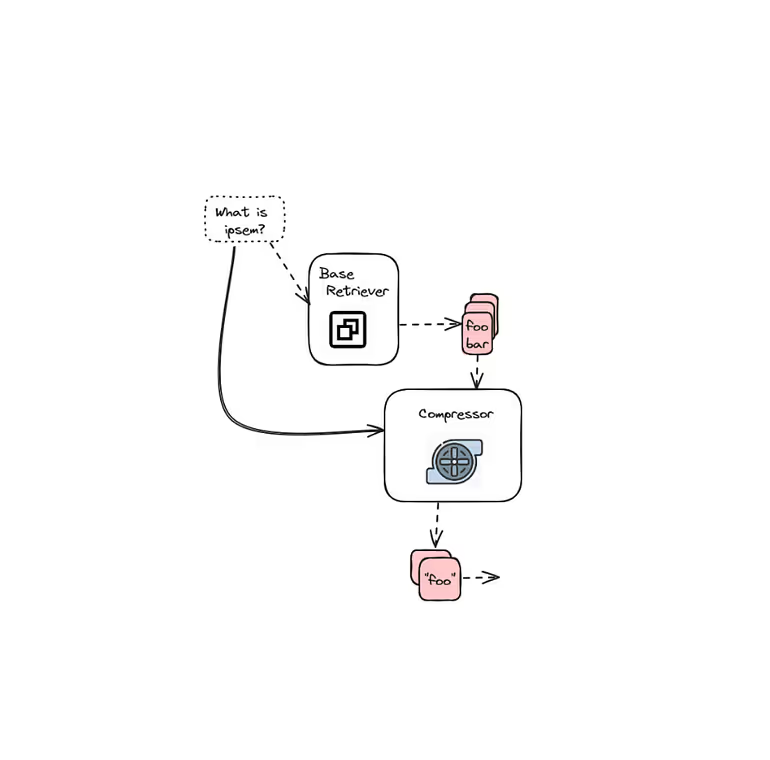
Contextual compression diagram

RAG (Retrieval Augmented Generation) lacks transparency in revealing what it retrieves, making it uncertain which questions the system will encounter. This results in valuable information getting lost amid a mass of irrelevant text, which is not ideal for a production-grade application.

Contextual compression addresses this issue with the following advantages:

  1. A fundamental retriever collects various pieces of information.
  2. This information is then passed through a document compressor.
  3. The compressor filters and processes the data, extracting meaningful information that is pertinent to the query.

You can observe a step-by-step demonstration of this process in an interactive Colab notebook.

Notebook Walk-through

Follow along with this Colab notebook.

For brevity, only important code blocks are presented here, please follow the above link for full python implementation.

We will be using HuggingFace models. Get your API token.

Load the Data (PDF)

loader = PyPDFLoader("Science_Glossary.pdf")
documents = loader.load()
print(len(documents))
print(documents[0].page_content)

Using BLING (Best Little Instruct-following No-GPU) model series on HuggingFace for Embeddings.

embeddings = SentenceTransformerEmbeddings(model_name="llmware/industry-bert-insurance-v0.1")

Instantiate the LLM

bling-sheared-llama-1.3b-0.1 is part of the BLING (Best Little Instruction-following No-GPU-required) model series, instruct trained on top of a Sheared-LLaMA-1.3B base model.

repo_id = "llmware/bling-sheared-llama-1.3b-0.1"
llm = HuggingFaceHub(repo_id=repo_id, model_kwargs={"temperature": 0.3, "max_length": 500})

Setting up LanceDB

context_data = lancedb.connect("./.lancedb")
table = context_data.create_table("context", data=[
    {"vector": embeddings.embed_query("Hello World"), "text": "Hello World", "id": "1"}
], mode="overwrite")

Retriever

retriever_d = database.as_retriever(search_kwargs={"k": 5, "include_metadata": True})

Now that we have set everything, let’s retrieve the relevant contexts that match the query.

docs = retriever.get_relevant_documents(query="What is Wetlands?")
pretty_print_docs(docs)
Initial retrieval results

We can see that the first two results are the most relevant to the query.

Let’s add Contextual Compression with LLMChainExtractor

  • LLMChainExtractor will iterate over the initially returned documents.
  • Extract only the relevant context to query from the documents.
from langchain.retrievers import ContextualCompressionRetriever
from langchain.retrievers.document_compressors import LLMChainExtractor

# creating the compressor
compressor = LLMChainExtractor.from_llm(llm=llm)

# compressor retriever = base retriever + compressor
compression_retriever = ContextualCompressionRetriever(
    base_retriever=retriever_d,
    base_compressor=compressor,
)

Now, will add Filters to Contextual Compressions

from getpass import getpass
import os
from langchain.embeddings import OpenAIEmbeddings
from langchain.retrievers.document_compressors import EmbeddingsFilter

os.environ["OPENAI_API_KEY"] = getpass()
embeddings_filter = EmbeddingsFilter(embeddings=embeddings)
compression_retriever_filter = ContextualCompressionRetriever(
    base_retriever=retriever_d, base_compressor=embeddings_filter
)

compressed_docs = compression_retriever_filter.get_relevant_documents(query="What is the Environment?")
pretty_print_docs(compressed_docs)

To get the result, we will utilize RetrievalQA Chain from Langchain.

from langchain.chains import RetrievalQA

qa = RetrievalQA.from_chain_type(
    llm=llm,
    chain_type="stuff",
    retriever=compression_retriever_filter,
    verbose=True,
)

# Ask Question
qa("What is Environment?")
RetrievalQA output

Pipelines

We can also join compressors and document transformers for better output and efficiency.

Here, we will create a pipeline comprising of redundant filter + relevant filter.

  • Redundant Filter: Identify similar documents and filter out redundancies.
  • Relevant Filter : Cleverly chooses the documents which are sufficiently relevant to a query.
from langchain.document_transformers import EmbeddingsRedundantFilter
from langchain.retrievers.document_compressors import DocumentCompressorPipeline

redundant_filter = EmbeddingsRedundantFilter(embeddings=embeddings)
relevant_filter = EmbeddingsFilter(embeddings=embeddings, k=5)

# creating the pipeline
compressed_pipeline = DocumentCompressorPipeline(transformers=[redundant_filter, relevant_filter])

# compressor retriever
comp_pipe_retrieve = ContextualCompressionRetriever(
    base_retriever=retriever_d, base_compressor=compressed_pipeline
)

# print the prompt
print(comp_pipe_retrieve)

# Get relevant documents
compressed_docs = comp_pipe_retrieve.get_relevant_documents(query="What is Environment?")
pretty_print_docs(compressed_docs)
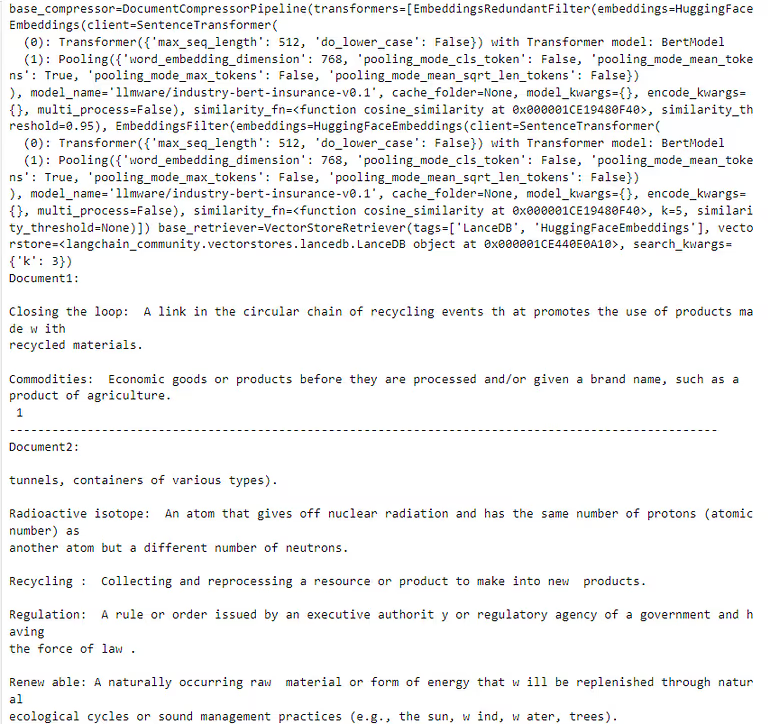
Compression pipeline results

We can see that it tries to gather the most relevant documents to query.

Visit LanceDB GitHub if you wish to learn more about LanceDB Python and Typescript library.
For more such applied GenAI and VectorDB applications, examples, and tutorials, visit VectorDB-Recipes.


Stable-Worldmodel: A High Performance Platform for Reproducible World Model Research

Ayush Chaurasia
Quentin Lhoest
Lucas Maes
Quentin Le Lidec
June 2, 2026
stable-worldmodel-a-high-performance-platform-for-reproducible-world-model-research

🌍 Lance-Backed World Model Platform, 🦆 Multimodal SQL with Lance DuckDB Extension, 💰 LanceDB vs OpenSearch Cost Breakdown

ChanChan Mao
May 28, 2026
newsletter-may-2026

Reproducible Data Curation In The Multimodal Lakehouse

Prashanth Rao
May 29, 2026
reproducible-data-curation-in-the-multimodal-lakehouse