stable-worldmodel-a-high-performance-platform-for-reproducible-world-model-research
Ayush Chaurasia
Quentin Lhoest
Lucas Maes
Quentin Le Lidec
reproducible-data-curation-in-the-multimodal-lakehouse
Prashanth Rao
newsletter-may-2026
ChanChan Mao
newsletter-april-2026
ChanChan Mao
how-lancedb-accelerates-vector-search-at-10-billion-scale
Yang Cen
opensearch-vs-lancedb-for-vector-search-query-cost-and-infrastructure
Justin Miller
volcano-engine-autonomous-driving-data-lake-solution
Kejian Ju
unifying-the-av-ml-stack-lancedb
Ayush Chaurasia
lance-json-support-why-you-might-not-really-need-variant
Jack Ye
building-a-storage-format-for-the-next-era-of-biology
Pavan Ramkumar
newsletter-march-2026
ChanChan Mao
smart-parsing-meets-sharp-retrieval-combining-liteparse-and-lancedb
Clelia Astra Bertelli
Prashanth Rao
lance-format-v2-2-benchmarks-half-the-storage-none-of-the-slowdown
Xuanwo
make-your-sql-workflows-multimodal-with-lancedb-x-duckdb
Prashanth Rao
agentic-coding-as-community-stewardship
Xuanwo
what-we-mean-by-multimodal
Prashanth Rao
ai-native-development-local-continue-lancedb
Ty Dunn
lance-file-format-2-2-taming-complex-data
Xuanwo
lance-blob-v2
Xuanwo
Jack Ye
openclaw-lancedb-memory-layer
Xuanwo
Prashanth Rao
openclaw-lancedb-seed2
LanceDB
openclaw-memory-from-zero-to-lancedb-pro
Prashanth Rao
upload-lance-datasets-to-hf-hub
Prashanth Rao
zero-shot-image-classification-with-vector-search
Vipul Maheshwari
werides-data-platform-transformation-how-lancedb-fuels-model-development-velocity
Qian Zhu
Fei Chen
training-a-variational-autoencoder-from-scratch-with-the-lance-file-format
LanceDB
track-ai-trends-crewai-agents-rag
LanceDB
tokens-per-second-is-not-all-you-need
Mingran Wang
Tan Li
the-future-of-open-source-table-formats-iceberg-and-lance
Jack Ye
the-case-for-random-access-i-o
LanceDB
series-a-funding
Chang She
semanticdotart
Ayush Chaurasia
second-dinners-secret-weapon-lancedb-powered-rag-for-faster-smarter-game-development
Qian Zhu
search-within-an-image-331b54e4285e
Kaushal Choudhary
scalable-computer-vision-with-lancedb-voxel51-d8b65066d5f6
LanceDB
rethinking-table-file-paths-lance-multi-base-layout
Jack Ye
rag-isnt-one-size-fits-all
Leonard Marcq
python-package-to-convert-image-datasets-to-lance-type
Vipul Maheshwari
one-million-iops
Weston Pace
november-feature-roundup
Will Jones
newsletter-september-2025
Jasmine Wang
newsletter-october-2025
Jasmine Wang
newsletter-november-2025
ChanChan Mao
newsletter-june-2025
David Myriel
newsletter-july-2025
Jasmine Wang
newsletter-january-2026
ChanChan Mao
newsletter-february-2026
ChanChan Mao
newsletter-december-2025
ChanChan Mao
newsletter-august-2025
Jasmine Wang
my-summer-internship-experience-at-lancedb-2
Raunak Sinha
my-simd-is-faster-than-yours-fb2989bf25e7
LanceDB
multimodal-myntra-fashion-search-engine-using-lancedb
LanceDB
multimodal-lakehouse
David Myriel
multi-document-agentic-rag-a-walkthrough
Vipul Maheshwari
modified-rag-parent-document-bigger-chunk-retriever-62b3d1e79bc6
Mahesh Deshwal
memgpt-os-inspired-llms-that-manage-their-own-memory-793d6eed417e
Ayush Chaurasia
late-interaction-efficient-multi-modal-retrievers-need-more-than-just-a-vector-index
Ayush Chaurasia
lancedb-x-continue
LanceDB
lance-x-huggingface-a-new-era-of-sharing-multimodal-data
Prashanth Rao
Quentin Lhoest
Xuanwo
Ayush Chaurasia
lance-x-duckdb-sql-retrieval-on-the-multimodal-lakehouse-format
Xuanwo
lance-windows-windows-lance
Chang She
lance-v2
Weston Pace
lance-namespace-lancedb-and-ray
Jack Ye
lance-file-2-1-stable
Weston Pace
lance-file-2-1-smaller-and-simpler
Weston Pace
lance-data-viewer
Gordon Murray
lance-community-governance
Jack Ye
introducing-lance-namespace-spark-integration
Jack Ye
implementing-corrective-rag-in-the-easiest-way-2
LanceDB
hybrid-search-rag-for-real-life-production-grade-applications-e1e727b3965a
Mahesh Deshwal
hybrid-search-combining-bm25-and-semantic-search-for-better-results-with-lan-1358038fe7e6
LanceDB
hybrid-search-and-custom-reranking-with-lancedb-4c10a6a3447e
LanceDB
how-to-reduce-hallucinations-from-llm-powered-agents-using-long-term-memory-72f262c3cc1f
Tevin Wang
guide-to-use-contextual-retrieval-and-prompt-caching-with-lancedb
LanceDB
grpo-understanding-and-fine-tuning-the-next-gen-reasoning-model-2
Mahesh Deshwal
graphrag-hierarchical-approach-to-retrieval-augmented-generation
Akash Desai
gpu-accelerated-indexing-in-lancedb-27558fa7eee5
LanceDB
geo-support
Jack Ye
geneva-twelvelabs
David Myriel
geneva-feature-engineering
Jonathan Hsieh
from-bi-to-ai-lance-and-iceberg
Jack Ye
Prashanth Rao
fluss-integration
Wayne Wang
file-readers-in-depth-parallelism-without-row-groups
Weston Pace
feature-rabitq-quantization
David Myriel
Yang Cen
feature-full-text-search
David Myriel
enhance-rag-integrate-contextual-compression-and-filtering-for-precision-a29d4a810301
Kaushal Choudhary
effortlessly-loading-and-processing-images-with-lance-a-code-walkthrough
LanceDB
designing-a-table-format-for-ml-workloads
Weston Pace
custom-dataset-for-llm-training-using-lance
LanceDB
creating-a-fintech-agent
Vipul Maheshwari
convert-any-image-dataset-to-lance
LanceDB
columnar-file-readers-in-depth-structural-encoding
Weston Pace
columnar-file-readers-in-depth-repetition-definition-levels
Weston Pace
columnar-file-readers-in-depth-compression-transparency
Weston Pace
columnar-file-readers-in-depth-column-shredding
Weston Pace
columnar-file-readers-in-depth-backpressure
Weston Pace
columnar-file-readers-in-depth-apis-and-fusion
Weston Pace
chunking-techniques-with-langchain-and-llamaindex
Prashant Kumar
chunking-analysis-which-is-the-right-chunking-approach-for-your-language
Shresth Shukla
chat-with-csv-excel-using-lancedb
LanceDB
case-study-netflix
David Myriel
case-study-dosu
Qian Zhu
Michael Ludden
case-study-cognee
David Myriel
Vasilije Markovic
case-study-coderabbit
Qian Zhu
building-rag-on-codebases-part-2
Sankalp Shubham
building-rag-on-codebases-part-1
Sankalp Shubham
branching-and-shallow-clone
Jack Ye
better-rag-with-active-retrieval-augmented-generation-flare-3b66646e2a9f
LanceDB
benchmarking-random-access-in-lance
Chang She
benchmarking-lancedb-92b01032874a-2
LanceDB
benchmarking-cohere-reranker-with-lancedb
LanceDB
anythingllms-competitive-edge-lancedb-for-seamless-rag-and-agent-workflows
Ayush Chaurasia
announcing-lance-sdk
Weston Pace
agentic-rag-using-langgraph-building-a-simple-customer-support-autonomous-agent
LanceDB
advanced-rag-precise-zero-shot-dense-retrieval-with-hyde-0946c54dfdcb
LanceDB
accelerate-vector-search-applications-using-openvino-lancedb
LanceDB
a-primer-on-text-chunking-and-its-types-a420efc96a13
Prashant Kumar
a-practical-guide-to-training-custom-rerankers
Ayush Chaurasia
a-practical-guide-to-fine-tuning-embedding-models
Ayush Chaurasia
keep-your-data-fresh-with-cocoindex-and-lancedb
Prashanth Rao
Linghua Jin

What is the LanceDB Multimodal Lakehouse?

June 23, 2025
Engineering

Multimodal Is No Longer Optional

Multimodality is no longer a niche capability. It is the foundation of every AI workflow that aims to operate in the real world.

Modern enterprises are already working with multimodal data, even if they don't call it that. PDFs, slide decks, contracts, sales calls, emails, and dashboards are part of daily operations. These inputs span formats: text, audio, images, structured metadata, and more.

Even if you're not generating media with AI, you're almost certainly consuming it.

Building AI that delivers real business value means connecting and interpreting information across these modalities. Though vector embeddings are powerful tools for comparison and retrieval, they aren't the whole picture.

You still need access to raw content and structured signals such as filenames, timestamps, captions, and bounding boxes to build applications that truly understand the data they're working with.

From Storage to Scalable Processing

Multimodal Lakehouse Architecture

If you've worked with our high-performance columnar format - Lance, you're already familiar with the foundation. Also, if you've used our vector database - LanceDB, then you've experienced how it can efficiently store and retrieve both structured and multimodal data.

However, as more teams build complex AI systems, they also need to transition seamlessly from rapid experimentation to large-scale production. In practice, many organizations get bogged down by brittle preprocessing scripts and fragmented pipelines.

Some of our largest customers posed essential questions:

  • How can we automate and accelerate feature engineering?
  • How do we scale across data modalities?
  • How do we transform raw data into training-ready datasets—without relying on complex orchestration tools or rebuilding infrastructure from scratch?

The Multimodal Lakehouse is Our Answer

LanceDB started as a vector database company, designed to handle both embeddings and diverse data types. You could run vector search and full-text search for a complete hybrid search experience relevant to search engines, RAG chatbots or all flavors of agentic systems.

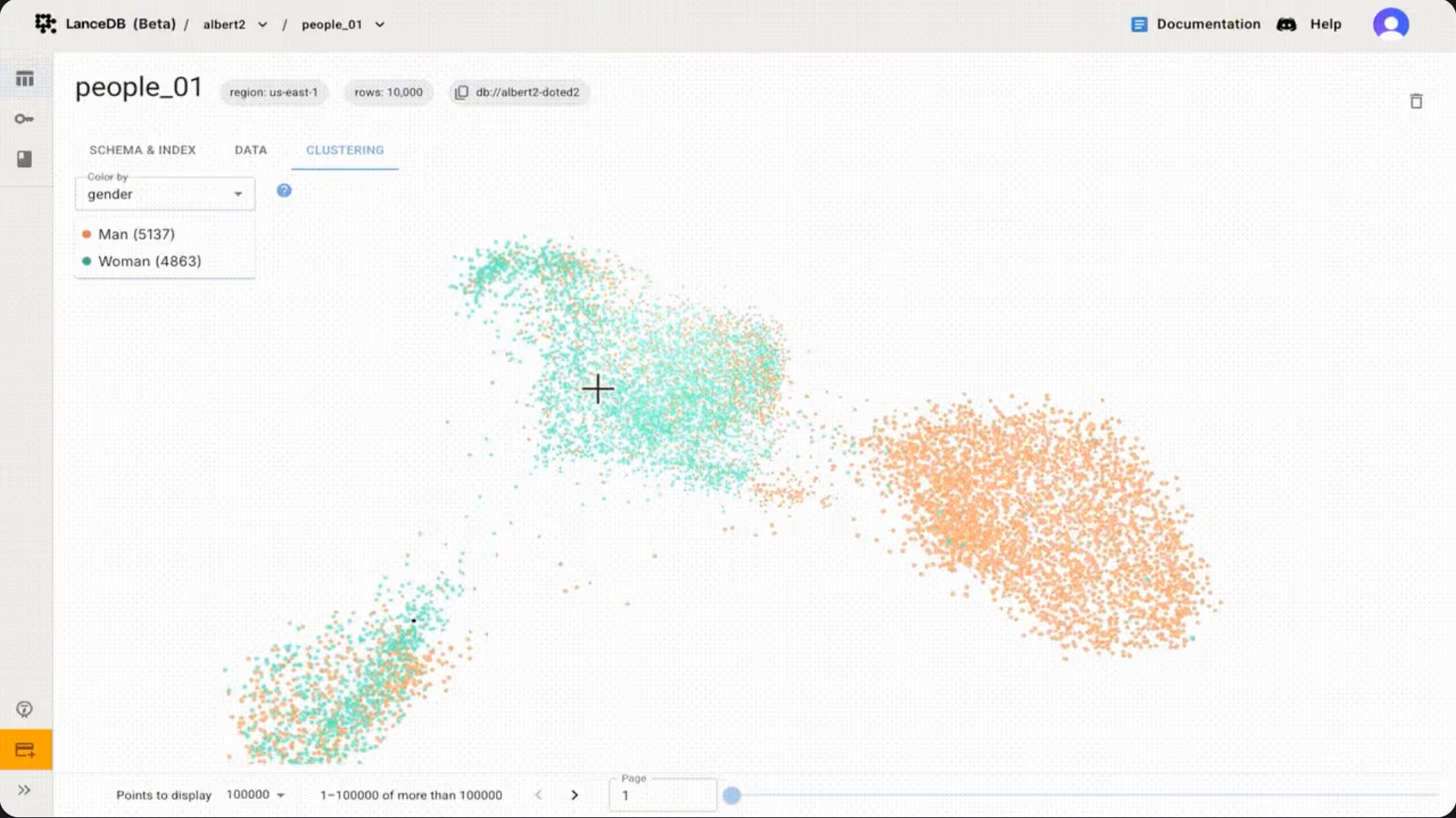
Figure 1: LanceDB Cloud will still offer a full vector search engine experience with added features such as clustering and dimensionality reduction.
Multimodal Lakehouse Architecture

This is where things start to diverge. In LanceDB Enterprise, Search is now one part of a broader platform.

As of June 24th, 2025, we are introducing the Multimodal Lakehouse suite of products into LanceDB Enterprise. The LanceDB Enterprise offering now consists of four features: Search, Exploratory Data Analysis, Feature Engineering and Training.
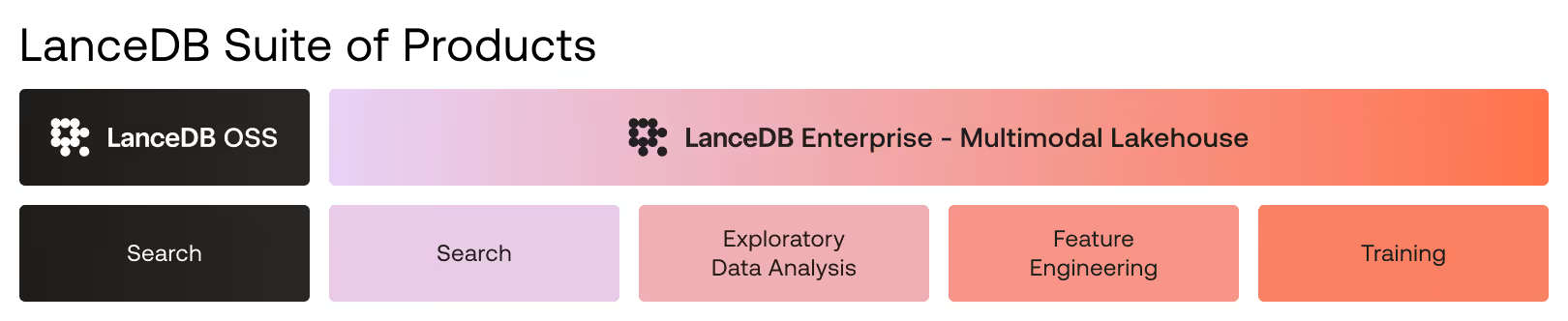
On top of Lance and LanceDB, The Multimodal Lakehouse adds a distributed serving engine, UDF-based feature engineering, materialized views, and SQL-based data exploration.

The accompanying Python package geneva, brings this vision to life with a simple, developer-friendly API.

Centralized Multimodal Data Management

The Multimodal Lakehouse acts as a flexible abstraction layer that connects to your existing LanceDB datasets. It empowers you to transform raw assets into usable AI-ready features without having to manage pipelines manually.

By centralizing data transformations, versioning, and distributed execution, the lakehouse becomes a shared foundation for AI teams working across modalities—video, image, text, audio or structured metadata.

Figure 2: Traditional Data Lakes are modular but fragmented, requiring teams to stitch together multiple systems, one for each kind of query. The Multimodal Lakehouse is cohesive and hybrid-query-native, offering vector, full-text, and SQL capabilities, with direct integration into modern ML and data tools.
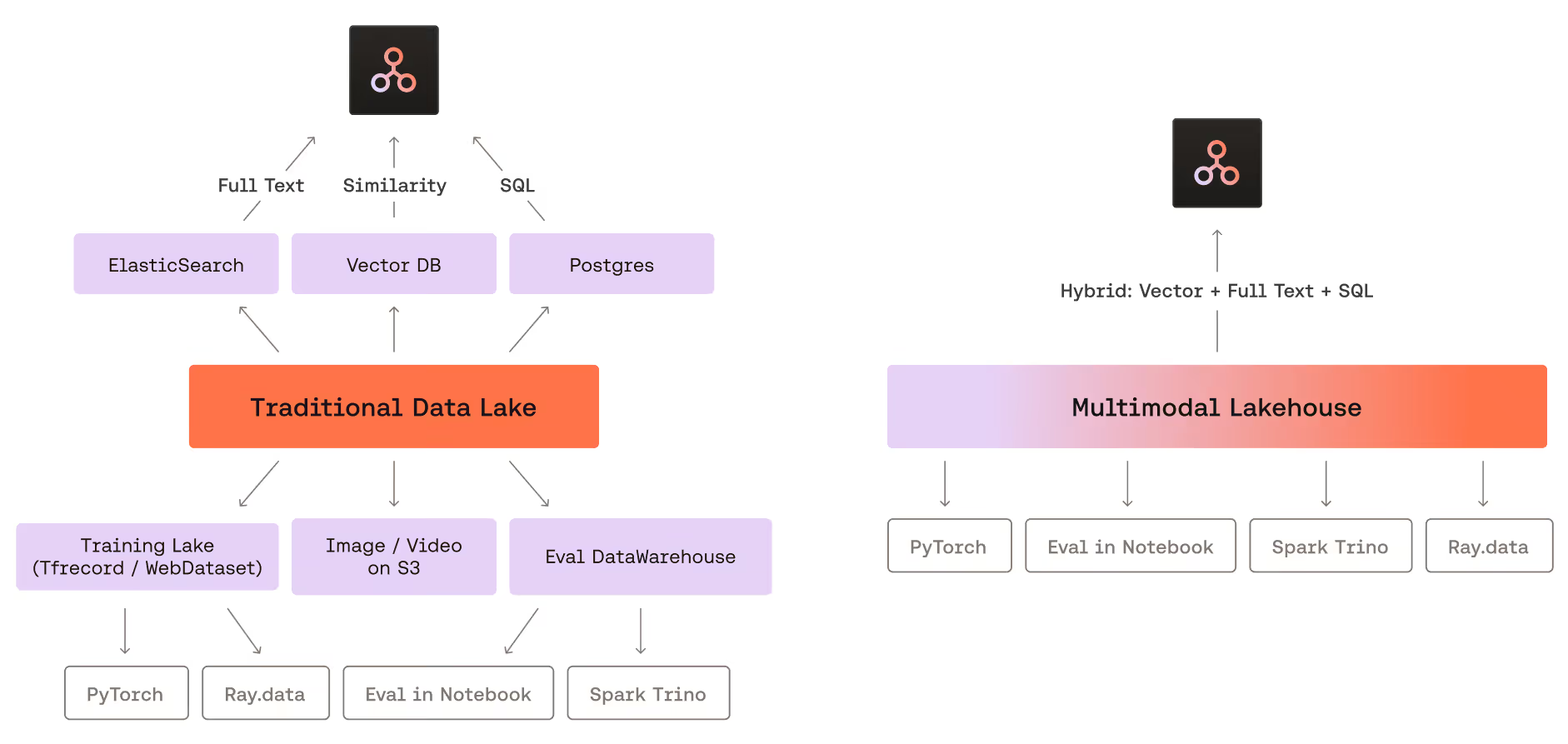
Traditional Data Lakes vs Multimodal Lakehouse

💡 The Single Source of Truth

Whether you're prototyping in a Jupyter notebook or orchestrating large backfills across GPUs, the same interface and abstractions apply. Teams across departments can align around a single source of truth for features, metrics, and data logic.

This architecture shift is what enables LanceDB to act not just as a vector database, but as a foundation for building AI-native platforms at scale.

Declarative Feature Engineering with Python UDFs

What makes the Multimodal Lakehouse unique is its deep integration with how data scientists and ML engineers already work.

Using the lakehouse starts with installing the geneva Python package:

Connect to your LanceDB table

After connecting to a LanceDB table, users can define feature logic as standard Python functions and apply them to their datasets via a simple API.

Traditionally, moving from experimentation to production involves porting notebook code into brittle DAGs, replicating environments, and managing task execution across compute nodes.

Define feature engineering functions

The lakehouse eliminates these steps. Users can write Python functions—decorated as UDFs—that are then scheduled, versioned, and executed across distributed infrastructure.

Behind the scenes, the platform packages your environment, deploys your code, and handles all the complexity of data partitioning, checkpointing, and incremental updates.

Query with hybrid search

Finally, you can easily go through your captions by either leveraging vector search, full-text search, SQL-based exploration or a hybrid combination.

Note: These operations are incremental by default. You can backfill only the rows that meet specific conditions and refresh materialized views as new data arrives. Whether working interactively or scheduling batch jobs, the same code paths are used, reducing complexity and increasing reliability.

The system supports scalar UDFs for per-row computation, batched UDFs for performance optimization using Apache Arrow, and stateful UDFs that can load models or external clients, which is ideal for embedding generation or inference tasks.

Scalable Compute with Ray and Kubernetes

The Multimodal Lakehouse doesn't just simplify development—it also scales. Through its integration with Ray and KubeRay, workloads can be distributed across clusters of CPUs and GPUs, either on-prem or in the cloud.

Compute resources can be provisioned dynamically and matched to your workload, whether it's CPU-bound document parsing or GPU-heavy model inference. Features like workload identity, custom Docker images, and execution control over concurrency and batch sizes make it easy to run high-throughput jobs securely and efficiently.

This infrastructure allows for massive scale-out of feature engineering, training data preparation, and inference preprocessing, which are all within the same declarative Python environment.

What Can You Do With the Multimodal Lakehouse?

Multimodal Lakehouse Architecture

The Multimodal Lakehouse supports a wide variety of AI workflows, making it a versatile tool for any modern ML organization. Some common use cases include:

Use Case Description
LLM Training Pipelines Extract, clean, and embed large text corpora for transformer-based models
Multimodal Vision + Language Systems Generate features across images, audio, and metadata for contrastive or fusion models
Semantic Search Engines Build rich hybrid search pipelines with embeddings, captions, thumbnails, and metadata
Recommender Systems Generate vector representations from logs, clicks, and metadata for nearest neighbor retrieval
AI Data Platforms Maintain end-to-end pipelines from raw data ingestion to clean, versioned, training-ready datasets

Focus on Data, Not Infrastructure

The core value of the Multimodal Lakehouse is letting teams focus on their data, not on DevOps. Engineers are no longer burdened with writing custom pipeline orchestration, debugging DAG dependencies, or manually scaling compute clusters. Instead, they can iterate on feature logic, monitor outputs, and let the platform handle execution.

The shift from building infrastructure to building data products unlocks faster experimentation, better collaboration, and more robust systems. It's a fundamentally different way to manage AI development.

This architecture marks the beginning of a new era for LanceDB. Instead of building disconnected tools, we're converging on a single, unified system for managing AI data from raw files to production-ready features.

Whether you're building a state-of-the-art semantic search system, a multimodal LLM training pipeline, or just want to simplify your feature engineering infrastructure, the multimodal lakehouse offers a production-ready, petabyte-scale solution with first class developer experience.

Looks like the sun's almost up. We're excited to see what you'll discover and what great things you'll build.


Multimodal Lakehouse Architecture
David Myriel
Writer, Software Engineer

Stable-Worldmodel: A High Performance Platform for Reproducible World Model Research

Ayush Chaurasia
Quentin Lhoest
Lucas Maes
Quentin Le Lidec
June 2, 2026
stable-worldmodel-a-high-performance-platform-for-reproducible-world-model-research

🌍 Lance-Backed World Model Platform, 🦆 Multimodal SQL with Lance DuckDB Extension, 💰 LanceDB vs OpenSearch Cost Breakdown

ChanChan Mao
May 28, 2026
newsletter-may-2026

Reproducible Data Curation In The Multimodal Lakehouse

Prashanth Rao
May 29, 2026
reproducible-data-curation-in-the-multimodal-lakehouse