stable-worldmodel-a-high-performance-platform-for-reproducible-world-model-research
Ayush Chaurasia
Quentin Lhoest
Lucas Maes
Quentin Le Lidec
reproducible-data-curation-in-the-multimodal-lakehouse
Prashanth Rao
newsletter-may-2026
ChanChan Mao
newsletter-april-2026
ChanChan Mao
how-lancedb-accelerates-vector-search-at-10-billion-scale
Yang Cen
opensearch-vs-lancedb-for-vector-search-query-cost-and-infrastructure
Justin Miller
volcano-engine-autonomous-driving-data-lake-solution
Kejian Ju
unifying-the-av-ml-stack-lancedb
Ayush Chaurasia
lance-json-support-why-you-might-not-really-need-variant
Jack Ye
building-a-storage-format-for-the-next-era-of-biology
Pavan Ramkumar
newsletter-march-2026
ChanChan Mao
smart-parsing-meets-sharp-retrieval-combining-liteparse-and-lancedb
Clelia Astra Bertelli
Prashanth Rao
lance-format-v2-2-benchmarks-half-the-storage-none-of-the-slowdown
Xuanwo
make-your-sql-workflows-multimodal-with-lancedb-x-duckdb
Prashanth Rao
agentic-coding-as-community-stewardship
Xuanwo
what-we-mean-by-multimodal
Prashanth Rao
ai-native-development-local-continue-lancedb
Ty Dunn
lance-file-format-2-2-taming-complex-data
Xuanwo
lance-blob-v2
Xuanwo
Jack Ye
openclaw-lancedb-memory-layer
Xuanwo
Prashanth Rao
openclaw-lancedb-seed2
LanceDB
openclaw-memory-from-zero-to-lancedb-pro
Prashanth Rao
upload-lance-datasets-to-hf-hub
Prashanth Rao
zero-shot-image-classification-with-vector-search
Vipul Maheshwari
werides-data-platform-transformation-how-lancedb-fuels-model-development-velocity
Qian Zhu
Fei Chen
training-a-variational-autoencoder-from-scratch-with-the-lance-file-format
LanceDB
track-ai-trends-crewai-agents-rag
LanceDB
tokens-per-second-is-not-all-you-need
Mingran Wang
Tan Li
the-future-of-open-source-table-formats-iceberg-and-lance
Jack Ye
the-case-for-random-access-i-o
LanceDB
series-a-funding
Chang She
semanticdotart
Ayush Chaurasia
second-dinners-secret-weapon-lancedb-powered-rag-for-faster-smarter-game-development
Qian Zhu
search-within-an-image-331b54e4285e
Kaushal Choudhary
scalable-computer-vision-with-lancedb-voxel51-d8b65066d5f6
LanceDB
rethinking-table-file-paths-lance-multi-base-layout
Jack Ye
rag-isnt-one-size-fits-all
Leonard Marcq
python-package-to-convert-image-datasets-to-lance-type
Vipul Maheshwari
one-million-iops
Weston Pace
november-feature-roundup
Will Jones
newsletter-september-2025
Jasmine Wang
newsletter-october-2025
Jasmine Wang
newsletter-november-2025
ChanChan Mao
newsletter-june-2025
David Myriel
newsletter-july-2025
Jasmine Wang
newsletter-january-2026
ChanChan Mao
newsletter-february-2026
ChanChan Mao
newsletter-december-2025
ChanChan Mao
newsletter-august-2025
Jasmine Wang
my-summer-internship-experience-at-lancedb-2
Raunak Sinha
my-simd-is-faster-than-yours-fb2989bf25e7
LanceDB
multimodal-myntra-fashion-search-engine-using-lancedb
LanceDB
multimodal-lakehouse
David Myriel
multi-document-agentic-rag-a-walkthrough
Vipul Maheshwari
modified-rag-parent-document-bigger-chunk-retriever-62b3d1e79bc6
Mahesh Deshwal
memgpt-os-inspired-llms-that-manage-their-own-memory-793d6eed417e
Ayush Chaurasia
late-interaction-efficient-multi-modal-retrievers-need-more-than-just-a-vector-index
Ayush Chaurasia
lancedb-x-continue
LanceDB
lance-x-huggingface-a-new-era-of-sharing-multimodal-data
Prashanth Rao
Quentin Lhoest
Xuanwo
Ayush Chaurasia
lance-x-duckdb-sql-retrieval-on-the-multimodal-lakehouse-format
Xuanwo
lance-windows-windows-lance
Chang She
lance-v2
Weston Pace
lance-namespace-lancedb-and-ray
Jack Ye
lance-file-2-1-stable
Weston Pace
lance-file-2-1-smaller-and-simpler
Weston Pace
lance-data-viewer
Gordon Murray
lance-community-governance
Jack Ye
introducing-lance-namespace-spark-integration
Jack Ye
implementing-corrective-rag-in-the-easiest-way-2
LanceDB
hybrid-search-rag-for-real-life-production-grade-applications-e1e727b3965a
Mahesh Deshwal
hybrid-search-combining-bm25-and-semantic-search-for-better-results-with-lan-1358038fe7e6
LanceDB
hybrid-search-and-custom-reranking-with-lancedb-4c10a6a3447e
LanceDB
how-to-reduce-hallucinations-from-llm-powered-agents-using-long-term-memory-72f262c3cc1f
Tevin Wang
guide-to-use-contextual-retrieval-and-prompt-caching-with-lancedb
LanceDB
grpo-understanding-and-fine-tuning-the-next-gen-reasoning-model-2
Mahesh Deshwal
graphrag-hierarchical-approach-to-retrieval-augmented-generation
Akash Desai
gpu-accelerated-indexing-in-lancedb-27558fa7eee5
LanceDB
geo-support
Jack Ye
geneva-twelvelabs
David Myriel
geneva-feature-engineering
Jonathan Hsieh
from-bi-to-ai-lance-and-iceberg
Jack Ye
Prashanth Rao
fluss-integration
Wayne Wang
file-readers-in-depth-parallelism-without-row-groups
Weston Pace
feature-rabitq-quantization
David Myriel
Yang Cen
feature-full-text-search
David Myriel
enhance-rag-integrate-contextual-compression-and-filtering-for-precision-a29d4a810301
Kaushal Choudhary
effortlessly-loading-and-processing-images-with-lance-a-code-walkthrough
LanceDB
designing-a-table-format-for-ml-workloads
Weston Pace
custom-dataset-for-llm-training-using-lance
LanceDB
creating-a-fintech-agent
Vipul Maheshwari
convert-any-image-dataset-to-lance
LanceDB
columnar-file-readers-in-depth-structural-encoding
Weston Pace
columnar-file-readers-in-depth-repetition-definition-levels
Weston Pace
columnar-file-readers-in-depth-compression-transparency
Weston Pace
columnar-file-readers-in-depth-column-shredding
Weston Pace
columnar-file-readers-in-depth-backpressure
Weston Pace
columnar-file-readers-in-depth-apis-and-fusion
Weston Pace
chunking-techniques-with-langchain-and-llamaindex
Prashant Kumar
chunking-analysis-which-is-the-right-chunking-approach-for-your-language
Shresth Shukla
chat-with-csv-excel-using-lancedb
LanceDB
case-study-netflix
David Myriel
case-study-dosu
Qian Zhu
Michael Ludden
case-study-cognee
David Myriel
Vasilije Markovic
case-study-coderabbit
Qian Zhu
building-rag-on-codebases-part-2
Sankalp Shubham
building-rag-on-codebases-part-1
Sankalp Shubham
branching-and-shallow-clone
Jack Ye
better-rag-with-active-retrieval-augmented-generation-flare-3b66646e2a9f
LanceDB
benchmarking-random-access-in-lance
Chang She
benchmarking-lancedb-92b01032874a-2
LanceDB
benchmarking-cohere-reranker-with-lancedb
LanceDB
anythingllms-competitive-edge-lancedb-for-seamless-rag-and-agent-workflows
Ayush Chaurasia
announcing-lance-sdk
Weston Pace
agentic-rag-using-langgraph-building-a-simple-customer-support-autonomous-agent
LanceDB
advanced-rag-precise-zero-shot-dense-retrieval-with-hyde-0946c54dfdcb
LanceDB
accelerate-vector-search-applications-using-openvino-lancedb
LanceDB
a-primer-on-text-chunking-and-its-types-a420efc96a13
Prashant Kumar
a-practical-guide-to-training-custom-rerankers
Ayush Chaurasia
a-practical-guide-to-fine-tuning-embedding-models
Ayush Chaurasia
keep-your-data-fresh-with-cocoindex-and-lancedb
Prashanth Rao
Linghua Jin

Benchmarking Random Access in Lance

March 14, 2023
Engineering

In this short blog post, we’ll take you through some simple benchmarks to show the random access performance of Lance format.

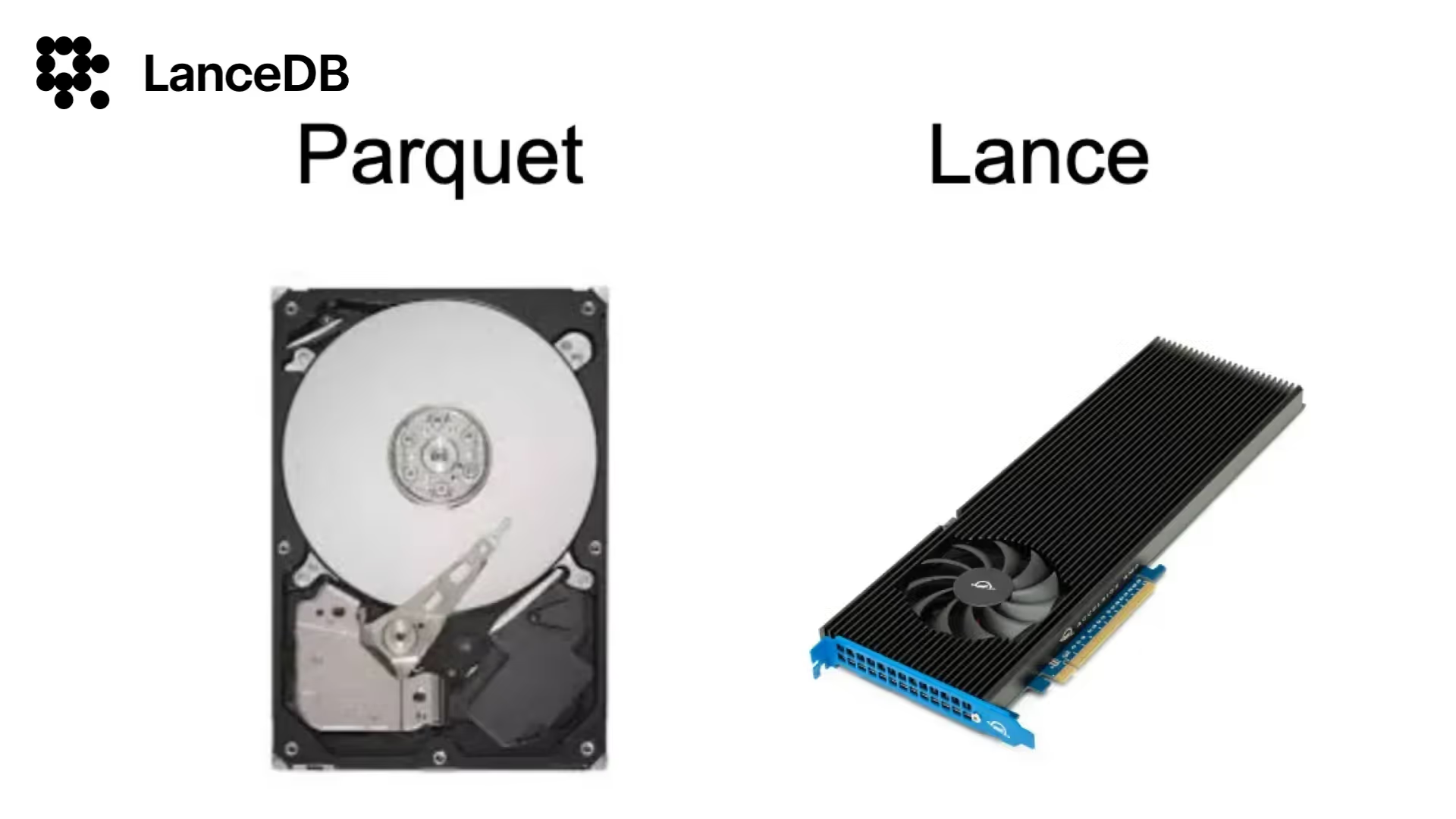
Lance delivers comparable scan performance to parquet but supports fast random access, making it perfect for:

  1. Search engines
  2. Real-time feature retrieval, and
  3. Speeding up shuffling performance for deep learning training

What makes Lance interesting is that in the existing tooling ecosystem, you either have to deal with the complexity of putting together multiple systems, OR, you have to deal with the expense of all in-memory stores. Moreover, Lance doesn’t require extra servers or complicated setup. pip install pylance is all you need.

💡 Check out the Lance format repo on GitHub here. https://github.com/lance-format/lance

Test setup

Here, we’re going to compare the random access performance of Lance vs parquet. We’ll create 100 million records where each value is a 1000-character long randomly generated string. We then run a benchmark of 1000 queries that fetch a random set of 20–50 rows across the dataset. Both tests are done on the same Ubuntu 22.04 system:

sudo lshw -short
Class          Description
=============================================================
system         20M9CTO1WW (LENOVO_MT_20M9_BU_Think_FM_ThinkPad P52)
memory         128GiB System Memory
memory         32GiB SODIMM DDR4 Synchronous 2667 MHz (0.4 ns)
memory         384KiB L1 cache
memory         1536KiB L2 cache
memory         12MiB L3 cache
processor      Intel(R) Xeon(R) E-2176M  CPU @ 2.70GHz
storage        Samsung SSD 980 PRO 2TB

Creating dataset

To run this benchmark we first generate 100 million entries, each of which is a 1000 character long string.

import lance
import pyarrow as pa
import random
import string

batch_size = 1_000_000

for i in range(100):
    print(f"Creating batch {i}")
    string_arr = pa.array([''.join(random.choices(string.ascii_letters, k=1_000))
                           for _ in range(batch_size)])
    tbl = pa.Table.from_arrays([string_arr], names=["value"])
    print(f"Writing batch {i} to lance")
    if i == 0:
        params = {"mode": "create"}
    else:
        params = {"mode": "append"}
    lance.write_dataset(tbl, "take.lance", **params)

Converting from Lance to parquet is just one line:

import lance
import pyarrow as pa

ds = lance.dataset("take.lance")
pa.dataset.write_dataset(ds.scanner().to_reader(),
                         "take.parquet",
                         format="parquet")

Benchmarking Take

For both datasets, we run 1000 queries each. For each query, we generate 20–50 row id’s randomly and then retrieve those rows and record the run time. We then compute the average time per key.

The API we use is Dataset.take:

import time
import numpy as np
import lance

tot_time = 0
tot_keys = 0
nruns = 1000
ds = lance.dataset("take.lance")

for _ in range(nruns):
    nrows = np.random.randint(20, 50, 1)
    row_ids = np.random.randint(0, 100_000_000, nrows)
    start = time.time()
    tbl = ds.take(row_ids)
    end = time.time()
    tot_time += end - start
    tot_keys += len(row_ids)

print(f"Lance: mean time per key is {tot_time / tot_keys}")

The parquet snippet is almost identical, so it’s omitted.

Here’s the output (in seconds):

Lance: mean time per key is 0.0006225714343229975
Parquet: mean time per key is 1.246656603929473

I also benchmarked a similar setup using LMDB and plotted all on the same chart for comparison:

Throughput is computed as:

\(\frac{1}{\text{mean time per key}}\)

Key lookup

If you’ve noticed, we’ve only benchmarked Dataset::Take on row ids. On the roadmap is to make this more generic so you can lookup arbitrary keys in any column.

Part of the limitation is in Lance itself. Currently looking up a particular key is done using a pyarrow Compute Expression, like the following:

dataset.to_table(columns=["value"], filter=pa.Field("key") == your_key)

Currently this requires scanning through the key column to find the right row ids, which adds more than 10ms to the query time. To solve this problem, we plan to a) calculate batch stats so we can b) implement batch pruning. And for super heavily queried key columns, c) adding a secondary index would make arbitrary key lookups much faster.

DuckDB integration

In Python, Lance is already queryable by DuckDB via the Arrow integration. However, one major shortcoming of DuckDB’s Arrow integration is the extremely limited filter pushdown. For example, pa.Field("key") == your_key is pushed down across the pyarrow interface, but multiple key lookups is not. This can be the difference between <10ms response time vs >500ms response time. In Lance OSS, we’re working on a native duckdb extension so that we don’t have to be subject to these limitations.

Conclusion

We’ve been claiming 100x faster random access performance than parquet, but as this benchmark shows, it’s really more like 2000x. Lance brings fast random access performance to the OSS data ecosystem needed by important ML workflows. This is critical for search, feature hydration, and shuffling for training deep learning models. While Lance’s performance is already very valuable for these use cases, we’ll be working to implement generalized key lookups, better duckdb integration, and hooks to distribute large Lance datasets across Spark/Ray nodes.

If any of these use cases apply to you, please give Lance a shot. We’d love to hear your feedback. If you like us, please give us a ⭐ on ️Github!


Chang She
CEO and Co-Founder of LanceDB

Stable-Worldmodel: A High Performance Platform for Reproducible World Model Research

Ayush Chaurasia
Quentin Lhoest
Lucas Maes
Quentin Le Lidec
June 2, 2026
stable-worldmodel-a-high-performance-platform-for-reproducible-world-model-research

🌍 Lance-Backed World Model Platform, 🦆 Multimodal SQL with Lance DuckDB Extension, 💰 LanceDB vs OpenSearch Cost Breakdown

ChanChan Mao
May 28, 2026
newsletter-may-2026

Reproducible Data Curation In The Multimodal Lakehouse

Prashanth Rao
May 29, 2026
reproducible-data-curation-in-the-multimodal-lakehouse