stable-worldmodel-a-high-performance-platform-for-reproducible-world-model-research
Ayush Chaurasia
Quentin Lhoest
Lucas Maes
Quentin Le Lidec
reproducible-data-curation-in-the-multimodal-lakehouse
Prashanth Rao
newsletter-may-2026
ChanChan Mao
newsletter-april-2026
ChanChan Mao
how-lancedb-accelerates-vector-search-at-10-billion-scale
Yang Cen
opensearch-vs-lancedb-for-vector-search-query-cost-and-infrastructure
Justin Miller
volcano-engine-autonomous-driving-data-lake-solution
Kejian Ju
unifying-the-av-ml-stack-lancedb
Ayush Chaurasia
lance-json-support-why-you-might-not-really-need-variant
Jack Ye
building-a-storage-format-for-the-next-era-of-biology
Pavan Ramkumar
newsletter-march-2026
ChanChan Mao
smart-parsing-meets-sharp-retrieval-combining-liteparse-and-lancedb
Clelia Astra Bertelli
Prashanth Rao
lance-format-v2-2-benchmarks-half-the-storage-none-of-the-slowdown
Xuanwo
make-your-sql-workflows-multimodal-with-lancedb-x-duckdb
Prashanth Rao
agentic-coding-as-community-stewardship
Xuanwo
what-we-mean-by-multimodal
Prashanth Rao
ai-native-development-local-continue-lancedb
Ty Dunn
lance-file-format-2-2-taming-complex-data
Xuanwo
lance-blob-v2
Xuanwo
Jack Ye
openclaw-lancedb-memory-layer
Xuanwo
Prashanth Rao
openclaw-lancedb-seed2
LanceDB
openclaw-memory-from-zero-to-lancedb-pro
Prashanth Rao
upload-lance-datasets-to-hf-hub
Prashanth Rao
zero-shot-image-classification-with-vector-search
Vipul Maheshwari
werides-data-platform-transformation-how-lancedb-fuels-model-development-velocity
Qian Zhu
Fei Chen
training-a-variational-autoencoder-from-scratch-with-the-lance-file-format
LanceDB
track-ai-trends-crewai-agents-rag
LanceDB
tokens-per-second-is-not-all-you-need
Mingran Wang
Tan Li
the-future-of-open-source-table-formats-iceberg-and-lance
Jack Ye
the-case-for-random-access-i-o
LanceDB
series-a-funding
Chang She
semanticdotart
Ayush Chaurasia
second-dinners-secret-weapon-lancedb-powered-rag-for-faster-smarter-game-development
Qian Zhu
search-within-an-image-331b54e4285e
Kaushal Choudhary
scalable-computer-vision-with-lancedb-voxel51-d8b65066d5f6
LanceDB
rethinking-table-file-paths-lance-multi-base-layout
Jack Ye
rag-isnt-one-size-fits-all
Leonard Marcq
python-package-to-convert-image-datasets-to-lance-type
Vipul Maheshwari
one-million-iops
Weston Pace
november-feature-roundup
Will Jones
newsletter-september-2025
Jasmine Wang
newsletter-october-2025
Jasmine Wang
newsletter-november-2025
ChanChan Mao
newsletter-june-2025
David Myriel
newsletter-july-2025
Jasmine Wang
newsletter-january-2026
ChanChan Mao
newsletter-february-2026
ChanChan Mao
newsletter-december-2025
ChanChan Mao
newsletter-august-2025
Jasmine Wang
my-summer-internship-experience-at-lancedb-2
Raunak Sinha
my-simd-is-faster-than-yours-fb2989bf25e7
LanceDB
multimodal-myntra-fashion-search-engine-using-lancedb
LanceDB
multimodal-lakehouse
David Myriel
multi-document-agentic-rag-a-walkthrough
Vipul Maheshwari
modified-rag-parent-document-bigger-chunk-retriever-62b3d1e79bc6
Mahesh Deshwal
memgpt-os-inspired-llms-that-manage-their-own-memory-793d6eed417e
Ayush Chaurasia
late-interaction-efficient-multi-modal-retrievers-need-more-than-just-a-vector-index
Ayush Chaurasia
lancedb-x-continue
LanceDB
lance-x-huggingface-a-new-era-of-sharing-multimodal-data
Prashanth Rao
Quentin Lhoest
Xuanwo
Ayush Chaurasia
lance-x-duckdb-sql-retrieval-on-the-multimodal-lakehouse-format
Xuanwo
lance-windows-windows-lance
Chang She
lance-v2
Weston Pace
lance-namespace-lancedb-and-ray
Jack Ye
lance-file-2-1-stable
Weston Pace
lance-file-2-1-smaller-and-simpler
Weston Pace
lance-data-viewer
Gordon Murray
lance-community-governance
Jack Ye
introducing-lance-namespace-spark-integration
Jack Ye
implementing-corrective-rag-in-the-easiest-way-2
LanceDB
hybrid-search-rag-for-real-life-production-grade-applications-e1e727b3965a
Mahesh Deshwal
hybrid-search-combining-bm25-and-semantic-search-for-better-results-with-lan-1358038fe7e6
LanceDB
hybrid-search-and-custom-reranking-with-lancedb-4c10a6a3447e
LanceDB
how-to-reduce-hallucinations-from-llm-powered-agents-using-long-term-memory-72f262c3cc1f
Tevin Wang
guide-to-use-contextual-retrieval-and-prompt-caching-with-lancedb
LanceDB
grpo-understanding-and-fine-tuning-the-next-gen-reasoning-model-2
Mahesh Deshwal
graphrag-hierarchical-approach-to-retrieval-augmented-generation
Akash Desai
gpu-accelerated-indexing-in-lancedb-27558fa7eee5
LanceDB
geo-support
Jack Ye
geneva-twelvelabs
David Myriel
geneva-feature-engineering
Jonathan Hsieh
from-bi-to-ai-lance-and-iceberg
Jack Ye
Prashanth Rao
fluss-integration
Wayne Wang
file-readers-in-depth-parallelism-without-row-groups
Weston Pace
feature-rabitq-quantization
David Myriel
Yang Cen
feature-full-text-search
David Myriel
enhance-rag-integrate-contextual-compression-and-filtering-for-precision-a29d4a810301
Kaushal Choudhary
effortlessly-loading-and-processing-images-with-lance-a-code-walkthrough
LanceDB
designing-a-table-format-for-ml-workloads
Weston Pace
custom-dataset-for-llm-training-using-lance
LanceDB
creating-a-fintech-agent
Vipul Maheshwari
convert-any-image-dataset-to-lance
LanceDB
columnar-file-readers-in-depth-structural-encoding
Weston Pace
columnar-file-readers-in-depth-repetition-definition-levels
Weston Pace
columnar-file-readers-in-depth-compression-transparency
Weston Pace
columnar-file-readers-in-depth-column-shredding
Weston Pace
columnar-file-readers-in-depth-backpressure
Weston Pace
columnar-file-readers-in-depth-apis-and-fusion
Weston Pace
chunking-techniques-with-langchain-and-llamaindex
Prashant Kumar
chunking-analysis-which-is-the-right-chunking-approach-for-your-language
Shresth Shukla
chat-with-csv-excel-using-lancedb
LanceDB
case-study-netflix
David Myriel
case-study-dosu
Qian Zhu
Michael Ludden
case-study-cognee
David Myriel
Vasilije Markovic
case-study-coderabbit
Qian Zhu
building-rag-on-codebases-part-2
Sankalp Shubham
building-rag-on-codebases-part-1
Sankalp Shubham
branching-and-shallow-clone
Jack Ye
better-rag-with-active-retrieval-augmented-generation-flare-3b66646e2a9f
LanceDB
benchmarking-random-access-in-lance
Chang She
benchmarking-lancedb-92b01032874a-2
LanceDB
benchmarking-cohere-reranker-with-lancedb
LanceDB
anythingllms-competitive-edge-lancedb-for-seamless-rag-and-agent-workflows
Ayush Chaurasia
announcing-lance-sdk
Weston Pace
agentic-rag-using-langgraph-building-a-simple-customer-support-autonomous-agent
LanceDB
advanced-rag-precise-zero-shot-dense-retrieval-with-hyde-0946c54dfdcb
LanceDB
accelerate-vector-search-applications-using-openvino-lancedb
LanceDB
a-primer-on-text-chunking-and-its-types-a420efc96a13
Prashant Kumar
a-practical-guide-to-training-custom-rerankers
Ayush Chaurasia
a-practical-guide-to-fine-tuning-embedding-models
Ayush Chaurasia
keep-your-data-fresh-with-cocoindex-and-lancedb
Prashanth Rao
Linghua Jin

GPU-Accelerated Indexing in LanceDB

November 2, 2023
Engineering

Vector databases are extremely useful for RAG, RecSys, computer vision, and a whole host of other ML/AI applications. Because of the rise of LLMs, there has been a lot of focus on vector indices, query latency, as well as the tradeoffs between latency and recall of various indices. What’s often neglected is the time it takes to build a vector index. Building a vector index is a very computationally intensive process that increases quadratically with the number of vectors or vector dimensions. As you scale up in production, this becomes a much bigger bottleneck for your AI stack.

Over the past few months, we’ve made some pretty amazing improvements using CPUs to build vector indices. And now we’re making a much bigger leap by supporting GPU acceleration for index building. So if you have access to an Nvidia GPU or a Macbook that supports MPS, you can now take advantage of the unparalleled computing power of GPUs when training large scale vector indices.

Training vector indices is expensive

Common indexing techniques like IVF (InVerted File index) or compression like PQ (Product Quantization) divide up the vectors into clusters. To find the cluster centroids, we have to use KMeans. While there are various techniques to improve the performance of KMeans, at the end of the day, it scales quadratically. This means that index training time quickly becomes prohibitively expensive at high scale.

The KMeans training algorithm is an iterative process where a ton of vector distance computations are performed to minimize the distance of vectors to their assigned clusters. It turns out that GPUs are amazingly good at this kind of math. Indexing libraries like FAISS, for example, support GPU-accelerated index training, but most vector databases have yet to add GPU support (and certainly haven’t made it easy).

LanceDB support for GPU-acceleration

Since the beginning of LanceDB, users managing embeddings at scale have asked for GPU-acceleration to speed up their index training. In the most recent release of the Python package of LanceDB (v0.3.3), backed by Lance (v0.8.10), you can now use either CUDA or MPS by simply specifying the “accelerator” parameter when calling create_index :

Using a GPU in LanceDB is as simple as specifying the accelerator parameter on create_index().
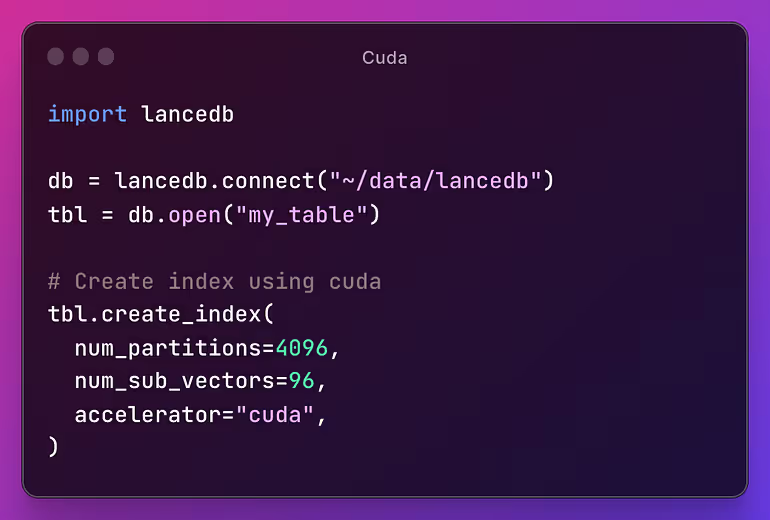
Creating index using Nvidia GPU (cuda)
Creating Index using Apple Silicon GPU (mps)

Under the hood, LanceDB uses PyTorch to train the IVF clusters, and passes the kmeans centroids to the Rust core for index serialization. Thanks to the high-quality support of Cuda and MPS from the PyTorch community, it allows us to quickly deliver on two of the most popular developer platforms (Linux and Mac). Combined with other recent improvements in the LanceDB indexing process, for instance, out-of-memory shuffling, batched KMeans training in GPU, LanceDB can reliably train over tens of millions vectors without worrying about CPU or GPU Out of Memory (OOM).

💡 Make sure you have pytorch installed (with CUDA if applicable) to use GPU-acceleration in LanceDB.

Results

To benchmark the performance improvement for KMeans training, we trained IVF_4096 (4096 clusters) using L2 euclidean distance on a 1-million vector dataset with OpenAI Ada2 embeddings (1536D). This was done on Linux and also on MacOS:

  • Google Cloud **g2-standard-32 **instance, 32 logical cores, and 1 x Nvidia L4 GPU, Ubuntu 22.04, nvidia-driver-525
  • Apple M2 Max Macbook Pro 14’, with 64GB RAM, 30 GPU cores.

In general, GPU acceleration offers up to 20–26x speed up compared to their CPU counterparts:

  • Linux VM: 323s on CPU, and 12.5s on GPU
  • Macbook Pro: 397s on CPU, and 21s on GPU
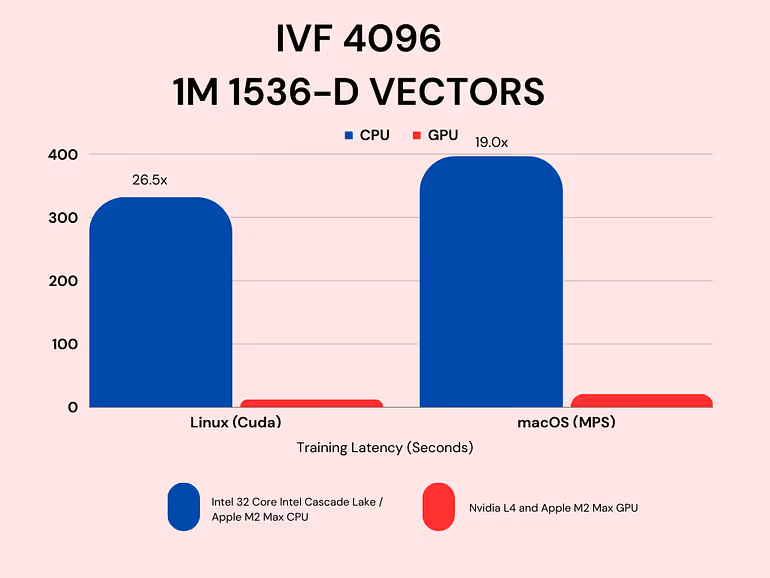
IVF 4096 on 1 Million 1536D vectors. BLUE is CPU; RED is GPU.

What’s next

Currently the IVF KMeans training is only one part of the whole index training process. We’re going to be working to add GPU acceleration for PQ training and also assigning the vectors to the correct centroids. Once this is completed, you’ll see even more drastic improvements in end-to-end index training time.

In addition, PyTorch offers LanceDB an easy path for large-scale distributed GPU training, as well as access to even more hardware accelerators (i.e., TPU via XLA) in the future. Imagine being able to train a vector index in minutes on billions of vectors, on any hardware.

Finally, now that we have a mechanism to use the GPU effectively, we could also use it for inference down the road.

Try it out!

You can start to leverage CUDA and Apple Silicon GPU support today via pip install lancedb. If you found this useful or interesting, please show us some love by starring LanceDB and the Lance format.

And if you’re looking for a highly scalable, hosted vector database, check out our enterprise offering at lancedb.com!


Stable-Worldmodel: A High Performance Platform for Reproducible World Model Research

Ayush Chaurasia
Quentin Lhoest
Lucas Maes
Quentin Le Lidec
June 2, 2026
stable-worldmodel-a-high-performance-platform-for-reproducible-world-model-research

🌍 Lance-Backed World Model Platform, 🦆 Multimodal SQL with Lance DuckDB Extension, 💰 LanceDB vs OpenSearch Cost Breakdown

ChanChan Mao
May 28, 2026
newsletter-may-2026

Reproducible Data Curation In The Multimodal Lakehouse

Prashanth Rao
May 29, 2026
reproducible-data-curation-in-the-multimodal-lakehouse