stable-worldmodel-a-high-performance-platform-for-reproducible-world-model-research
Ayush Chaurasia
Quentin Lhoest
Lucas Maes
Quentin Le Lidec
reproducible-data-curation-in-the-multimodal-lakehouse
Prashanth Rao
newsletter-may-2026
ChanChan Mao
newsletter-april-2026
ChanChan Mao
how-lancedb-accelerates-vector-search-at-10-billion-scale
Yang Cen
opensearch-vs-lancedb-for-vector-search-query-cost-and-infrastructure
Justin Miller
volcano-engine-autonomous-driving-data-lake-solution
Kejian Ju
unifying-the-av-ml-stack-lancedb
Ayush Chaurasia
lance-json-support-why-you-might-not-really-need-variant
Jack Ye
building-a-storage-format-for-the-next-era-of-biology
Pavan Ramkumar
newsletter-march-2026
ChanChan Mao
smart-parsing-meets-sharp-retrieval-combining-liteparse-and-lancedb
Clelia Astra Bertelli
Prashanth Rao
lance-format-v2-2-benchmarks-half-the-storage-none-of-the-slowdown
Xuanwo
make-your-sql-workflows-multimodal-with-lancedb-x-duckdb
Prashanth Rao
agentic-coding-as-community-stewardship
Xuanwo
what-we-mean-by-multimodal
Prashanth Rao
ai-native-development-local-continue-lancedb
Ty Dunn
lance-file-format-2-2-taming-complex-data
Xuanwo
lance-blob-v2
Xuanwo
Jack Ye
openclaw-lancedb-memory-layer
Xuanwo
Prashanth Rao
openclaw-lancedb-seed2
LanceDB
openclaw-memory-from-zero-to-lancedb-pro
Prashanth Rao
upload-lance-datasets-to-hf-hub
Prashanth Rao
zero-shot-image-classification-with-vector-search
Vipul Maheshwari
werides-data-platform-transformation-how-lancedb-fuels-model-development-velocity
Qian Zhu
Fei Chen
training-a-variational-autoencoder-from-scratch-with-the-lance-file-format
LanceDB
track-ai-trends-crewai-agents-rag
LanceDB
tokens-per-second-is-not-all-you-need
Mingran Wang
Tan Li
the-future-of-open-source-table-formats-iceberg-and-lance
Jack Ye
the-case-for-random-access-i-o
LanceDB
series-a-funding
Chang She
semanticdotart
Ayush Chaurasia
second-dinners-secret-weapon-lancedb-powered-rag-for-faster-smarter-game-development
Qian Zhu
search-within-an-image-331b54e4285e
Kaushal Choudhary
scalable-computer-vision-with-lancedb-voxel51-d8b65066d5f6
LanceDB
rethinking-table-file-paths-lance-multi-base-layout
Jack Ye
rag-isnt-one-size-fits-all
Leonard Marcq
python-package-to-convert-image-datasets-to-lance-type
Vipul Maheshwari
one-million-iops
Weston Pace
november-feature-roundup
Will Jones
newsletter-september-2025
Jasmine Wang
newsletter-october-2025
Jasmine Wang
newsletter-november-2025
ChanChan Mao
newsletter-june-2025
David Myriel
newsletter-july-2025
Jasmine Wang
newsletter-january-2026
ChanChan Mao
newsletter-february-2026
ChanChan Mao
newsletter-december-2025
ChanChan Mao
newsletter-august-2025
Jasmine Wang
my-summer-internship-experience-at-lancedb-2
Raunak Sinha
my-simd-is-faster-than-yours-fb2989bf25e7
LanceDB
multimodal-myntra-fashion-search-engine-using-lancedb
LanceDB
multimodal-lakehouse
David Myriel
multi-document-agentic-rag-a-walkthrough
Vipul Maheshwari
modified-rag-parent-document-bigger-chunk-retriever-62b3d1e79bc6
Mahesh Deshwal
memgpt-os-inspired-llms-that-manage-their-own-memory-793d6eed417e
Ayush Chaurasia
late-interaction-efficient-multi-modal-retrievers-need-more-than-just-a-vector-index
Ayush Chaurasia
lancedb-x-continue
LanceDB
lance-x-huggingface-a-new-era-of-sharing-multimodal-data
Prashanth Rao
Quentin Lhoest
Xuanwo
Ayush Chaurasia
lance-x-duckdb-sql-retrieval-on-the-multimodal-lakehouse-format
Xuanwo
lance-windows-windows-lance
Chang She
lance-v2
Weston Pace
lance-namespace-lancedb-and-ray
Jack Ye
lance-file-2-1-stable
Weston Pace
lance-file-2-1-smaller-and-simpler
Weston Pace
lance-data-viewer
Gordon Murray
lance-community-governance
Jack Ye
introducing-lance-namespace-spark-integration
Jack Ye
implementing-corrective-rag-in-the-easiest-way-2
LanceDB
hybrid-search-rag-for-real-life-production-grade-applications-e1e727b3965a
Mahesh Deshwal
hybrid-search-combining-bm25-and-semantic-search-for-better-results-with-lan-1358038fe7e6
LanceDB
hybrid-search-and-custom-reranking-with-lancedb-4c10a6a3447e
LanceDB
how-to-reduce-hallucinations-from-llm-powered-agents-using-long-term-memory-72f262c3cc1f
Tevin Wang
guide-to-use-contextual-retrieval-and-prompt-caching-with-lancedb
LanceDB
grpo-understanding-and-fine-tuning-the-next-gen-reasoning-model-2
Mahesh Deshwal
graphrag-hierarchical-approach-to-retrieval-augmented-generation
Akash Desai
gpu-accelerated-indexing-in-lancedb-27558fa7eee5
LanceDB
geo-support
Jack Ye
geneva-twelvelabs
David Myriel
geneva-feature-engineering
Jonathan Hsieh
from-bi-to-ai-lance-and-iceberg
Jack Ye
Prashanth Rao
fluss-integration
Wayne Wang
file-readers-in-depth-parallelism-without-row-groups
Weston Pace
feature-rabitq-quantization
David Myriel
Yang Cen
feature-full-text-search
David Myriel
enhance-rag-integrate-contextual-compression-and-filtering-for-precision-a29d4a810301
Kaushal Choudhary
effortlessly-loading-and-processing-images-with-lance-a-code-walkthrough
LanceDB
designing-a-table-format-for-ml-workloads
Weston Pace
custom-dataset-for-llm-training-using-lance
LanceDB
creating-a-fintech-agent
Vipul Maheshwari
convert-any-image-dataset-to-lance
LanceDB
columnar-file-readers-in-depth-structural-encoding
Weston Pace
columnar-file-readers-in-depth-repetition-definition-levels
Weston Pace
columnar-file-readers-in-depth-compression-transparency
Weston Pace
columnar-file-readers-in-depth-column-shredding
Weston Pace
columnar-file-readers-in-depth-backpressure
Weston Pace
columnar-file-readers-in-depth-apis-and-fusion
Weston Pace
chunking-techniques-with-langchain-and-llamaindex
Prashant Kumar
chunking-analysis-which-is-the-right-chunking-approach-for-your-language
Shresth Shukla
chat-with-csv-excel-using-lancedb
LanceDB
case-study-netflix
David Myriel
case-study-dosu
Qian Zhu
Michael Ludden
case-study-cognee
David Myriel
Vasilije Markovic
case-study-coderabbit
Qian Zhu
building-rag-on-codebases-part-2
Sankalp Shubham
building-rag-on-codebases-part-1
Sankalp Shubham
branching-and-shallow-clone
Jack Ye
better-rag-with-active-retrieval-augmented-generation-flare-3b66646e2a9f
LanceDB
benchmarking-random-access-in-lance
Chang She
benchmarking-lancedb-92b01032874a-2
LanceDB
benchmarking-cohere-reranker-with-lancedb
LanceDB
anythingllms-competitive-edge-lancedb-for-seamless-rag-and-agent-workflows
Ayush Chaurasia
announcing-lance-sdk
Weston Pace
agentic-rag-using-langgraph-building-a-simple-customer-support-autonomous-agent
LanceDB
advanced-rag-precise-zero-shot-dense-retrieval-with-hyde-0946c54dfdcb
LanceDB
accelerate-vector-search-applications-using-openvino-lancedb
LanceDB
a-primer-on-text-chunking-and-its-types-a420efc96a13
Prashant Kumar
a-practical-guide-to-training-custom-rerankers
Ayush Chaurasia
a-practical-guide-to-fine-tuning-embedding-models
Ayush Chaurasia
keep-your-data-fresh-with-cocoindex-and-lancedb
Prashanth Rao
Linghua Jin

Inverted File Product Quantization (IVF_PQ): Accelerate Vector Search by Creating Indices

December 17, 2023
Engineering

Vector similarity search is finding similar vectors from a list of given vectors in a particular embedding space. It plays a vital role in various fields and applications because it efficiently retrieves relevant information from large datasets.

Vector similarity search requires excessive memory resources for efficient search, especially when dealing with dense vector datasets. Here comes the role of compressing high-dimensional vectors for optimizing memory storage. In this blog, we’ll discuss

  1. Product Quantization(PQ) & How it works
  2. Inverted File Product Quantization(IVFPQ) Index
  3. Implementation of IVFPQ using LanceDB

We’ll also see the performance of PQ and IVFPQ in terms of memory and cover an implementation of the IVFPQ Index using LanceDB.

Quantization is a process used for dimensional reduction without losing important information.

Quantization: Dimensionality Reduction

How does Product Quantization work?

Product Quantization can be broken down into steps listed below:

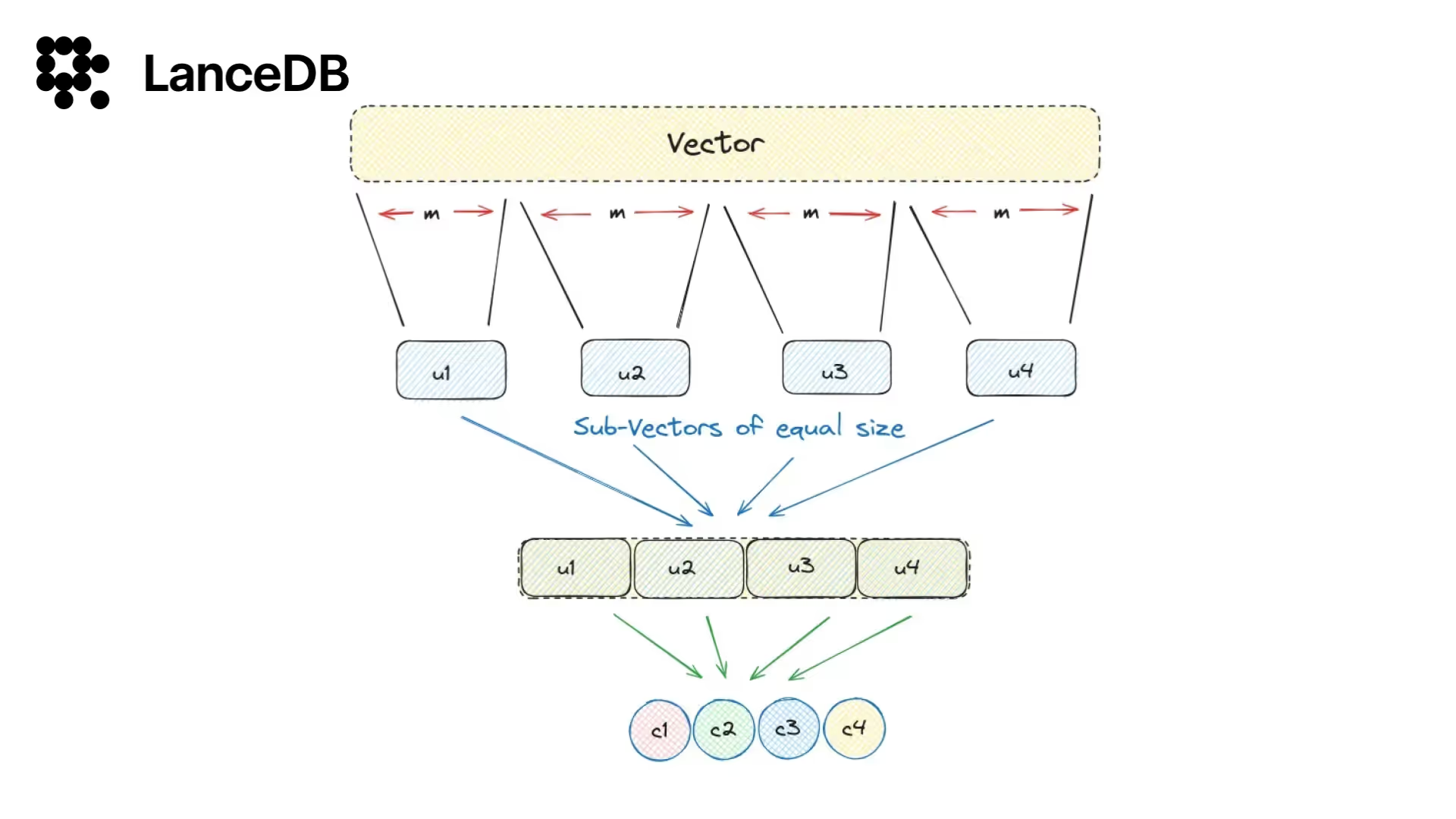
  1. Divide a large, high-dimensional vector into equally sized chunks, creating subvectors.
  2. Identify the nearest centroid for each subvector, referring to it as reproduction or reconstruction values.
  3. Replace these reproduction values with unique IDs that represent the corresponding centroids.
Product Quantization


Let’s see how it works in the implementation; for that we’ll create a random array of size 12 and keep the chunk size as 3.

import random

# consider this as a high dimensional vector
vec = [random.randint(1, 20) for i in range(12)]
chunk_count = 4
vector_size = len(vec)

# vector_size must be divisible by chunk_count
assert vector_size % chunk_count == 0

# length of each subvector will be vector_size / chunk_count
subvector_size = int(vector_size / chunk_count)

# subvectors
sub_vectors = [vec[row: row + subvector_size] for row in range(0, vector_size, subvector_size)]
sub_vectors

The output looks like this:

[[13, 3, 2], [5, 13, 5], [17, 8, 5], [3, 12, 9]]

These subvectors are substituted with a designated centroid vector called Reproduction Value because it helps identify each subvector. Subsequently, this centroid vector can be substituted with a distinct ID that is unique to it.

k = 2 ** 5
assert k % chunk_count == 0
k_ = int(k / chunk_count)

from random import randint

# reproduction values
c = []
for j in range(chunk_count):
    # each j represents a subvector position
    c_j = []
    for i in range(k_):
        # each i represents a cluster/reproduction value position
        c_ji = [randint(0, 9) for _ in range(subvector_size)]
        c_j.append(c_ji)  # add cluster centroid to subspace list
    # add subspace list of centroids
    c.append(c_j)

# helper function to calculate euclidean distance
def euclidean(v, u):
    distance = sum((x - y) ** 2 for x, y in zip(v, u)) ** 0.5
    return distance

# helper function to create unique ids
def nearest(c_j, chunk_j):
    distance = 9e9
    for i in range(k_):
        new_dist = euclidean(c_j[i], chunk_j)
        if new_dist < distance:
            nearest_idx = i
            distance = new_dist
    return nearest_idx

Now, let’s see how we can get unique centroid IDs using the nearest helper function.

ids = []
# unique centroid IDs for each subvector
for j in range(chunk_count):
    i = nearest(c[j], sub_vectors[j])
    ids.append(i)
print(ids)

Output shows unique centroid IDs for each subvector:

[5, 6, 7, 7]

When utilizing PQ to handle a vector, we divide it into subvectors. These subvectors are then processed and linked to their closest centroids, also known as reproduction values, within the respective subclusters.

Instead of saving our Quantized Vector using the centroids, we substitute it with a unique Centroid ID. Each centroid has its specific ID, allowing us to later map these ID values back to the complete centroids.

quantized = []
for j in range(chunk_count):
    c_ji = c[j][ids[j]]
    quantized.extend(c_ji)

print(quantized)

Here is the reconstructed vector using Centroid IDs:

[9, 9, 2, 5, 7, 6, 8, 3, 5, 2, 9, 4]

In doing so, we’ve condensed a 12-dimensional vector into a 4-dimensional vector represented by IDs. We opted for a smaller dimensionality for simplicity, which might make the advantages of this technique less immediately apparent.

It’s important to highlight that the reconstructed vector is not identical to the original vector. This discrepancy arises due to inherent losses during the compression and reconstruction process in all compression algorithms.

Let’s change our starting 12-dimensional vector made of 8-bit integers to a more practical 128-dimensional vector of 32-bit floats. By compressing it to an 8-bit integer vector with only eight dimensions, we strike a good balance in performance.

Original: 128×32 = 4096   Quantized: 8×8 = 64

This marks a substantial difference — a 64x reduction in memory.

How does IVFPQ Index help in speeding things up?

In IVFPQ, an Inverted File index (IVF) is integrated with Product Quantization (PQ) to facilitate a rapid and effective approximate nearest neighbor search by initial broad-stroke that narrows down the scope of vectors in our search.

After this, we continue our PQ search as we did before — but with a significantly reduced number of vectors. By minimizing our Search Scope, it is anticipated to achieve significantly improved search speeds.

IVFPQ can be very easily implemented in just a few lines of code using LanceDB

Creating an IVF_PQ Index

import lancedb
import numpy as np
uri = "./lancedb"
db = lancedb.connect(uri)

# Create 10,000 sample vectors
data = [{"vector": row, "item": f"item {i}"}
   for i, row in enumerate(np.random.random((10_000, 1536)).astype('float32'))]

# Add the vectors to a table
tbl = db.create_table("my_vectors", data=data)

# Create and train the index - you need enough data in the table for an effective training step
tbl.create_index(num_partitions=256, num_sub_vectors=96)

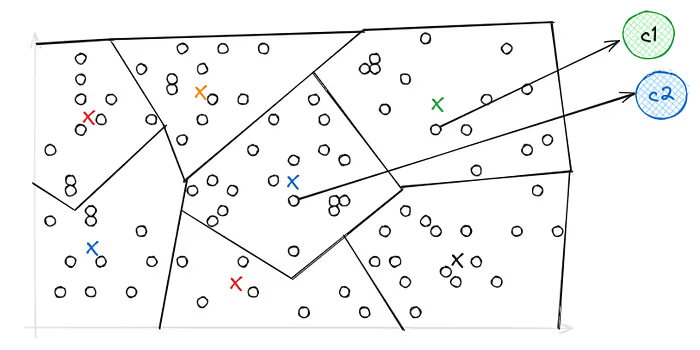
Now let’s see what this IVF Index does to reduce the scope of vectors. An inverted file is an index structure that is used to map database vectors to their respective partitions where these vectors reside.
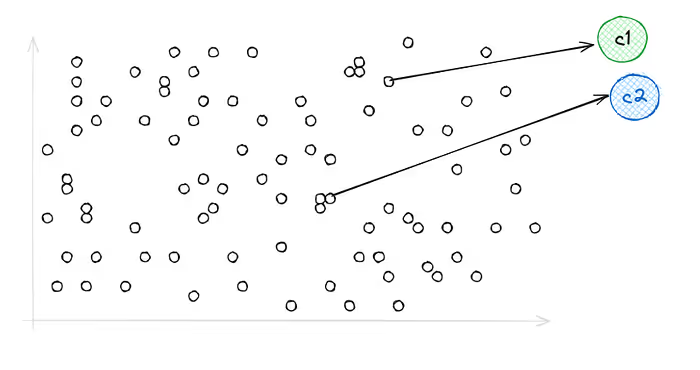
PQ vectors
Vectors assigned to Voronoi cells via IVF

This is Voronoi’s Representation of vectors using IVF, they’re simply a set of partitions each containing vectors close to each other, and when it comes to search — When we introduce our query vector, it restricts our search to the nearest cells only because of which searching becomes way faster compared to PQ.
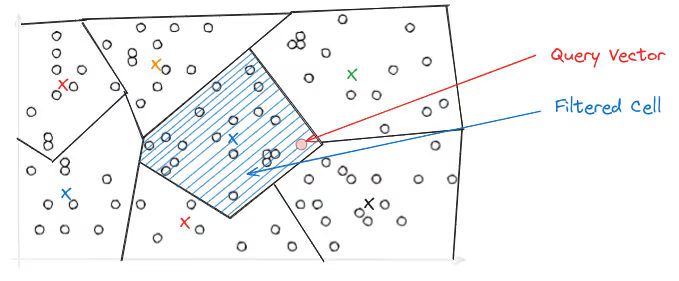
Query Vector searches closest cell

Afterwards, PQ needs to be applied as we have seen above.

All of this can be applied using the IVF+PQ Index using LanceDB in minimal lines of code

tbl.search(np.random.random((1536))) \
    .limit(2) \
    .nprobes(20) \
    .refine_factor(10) \
    .to_pandas()
  • limit (default: 10): The number of results that will be returned
  • n-probes (default: 20): The quantity of probes (sections) determines the distribution of vector space. While a higher number enhances search accuracy, it also results in slower performance. Typically, setting the number of probes (n-probes) to cover 5–10% of the dataset proves effective in achieving high recall with minimal latency.
  • refine_factor (default: None): Refine the results by reading extra elements and re-ranking them in memory. A higher number makes the search more accurate but also slower.

Conclusion

In summary, Product Quantization helps reduce memory usage when storing high-dimensional vectors. Along with the IVF index, it significantly speeds up the search process by focusing only on the nearest vectors.

Visit the LanceDBrepo to learn more about LanceDB Python and Typescript library

To discover more such applied GenAI and vectorDB applications, examples and tutorials visit vectordb-recipes


Stable-Worldmodel: A High Performance Platform for Reproducible World Model Research

Ayush Chaurasia
Quentin Lhoest
Lucas Maes
Quentin Le Lidec
June 2, 2026
stable-worldmodel-a-high-performance-platform-for-reproducible-world-model-research

🌍 Lance-Backed World Model Platform, 🦆 Multimodal SQL with Lance DuckDB Extension, 💰 LanceDB vs OpenSearch Cost Breakdown

ChanChan Mao
May 28, 2026
newsletter-may-2026

Reproducible Data Curation In The Multimodal Lakehouse

Prashanth Rao
May 29, 2026
reproducible-data-curation-in-the-multimodal-lakehouse