stable-worldmodel-a-high-performance-platform-for-reproducible-world-model-research
Ayush Chaurasia
Quentin Lhoest
Lucas Maes
Quentin Le Lidec
reproducible-data-curation-in-the-multimodal-lakehouse
Prashanth Rao
newsletter-may-2026
ChanChan Mao
newsletter-april-2026
ChanChan Mao
how-lancedb-accelerates-vector-search-at-10-billion-scale
Yang Cen
opensearch-vs-lancedb-for-vector-search-query-cost-and-infrastructure
Justin Miller
volcano-engine-autonomous-driving-data-lake-solution
Kejian Ju
unifying-the-av-ml-stack-lancedb
Ayush Chaurasia
lance-json-support-why-you-might-not-really-need-variant
Jack Ye
building-a-storage-format-for-the-next-era-of-biology
Pavan Ramkumar
newsletter-march-2026
ChanChan Mao
smart-parsing-meets-sharp-retrieval-combining-liteparse-and-lancedb
Clelia Astra Bertelli
Prashanth Rao
lance-format-v2-2-benchmarks-half-the-storage-none-of-the-slowdown
Xuanwo
make-your-sql-workflows-multimodal-with-lancedb-x-duckdb
Prashanth Rao
agentic-coding-as-community-stewardship
Xuanwo
what-we-mean-by-multimodal
Prashanth Rao
ai-native-development-local-continue-lancedb
Ty Dunn
lance-file-format-2-2-taming-complex-data
Xuanwo
lance-blob-v2
Xuanwo
Jack Ye
openclaw-lancedb-memory-layer
Xuanwo
Prashanth Rao
openclaw-lancedb-seed2
LanceDB
openclaw-memory-from-zero-to-lancedb-pro
Prashanth Rao
upload-lance-datasets-to-hf-hub
Prashanth Rao
zero-shot-image-classification-with-vector-search
Vipul Maheshwari
werides-data-platform-transformation-how-lancedb-fuels-model-development-velocity
Qian Zhu
Fei Chen
training-a-variational-autoencoder-from-scratch-with-the-lance-file-format
LanceDB
track-ai-trends-crewai-agents-rag
LanceDB
tokens-per-second-is-not-all-you-need
Mingran Wang
Tan Li
the-future-of-open-source-table-formats-iceberg-and-lance
Jack Ye
the-case-for-random-access-i-o
LanceDB
series-a-funding
Chang She
semanticdotart
Ayush Chaurasia
second-dinners-secret-weapon-lancedb-powered-rag-for-faster-smarter-game-development
Qian Zhu
search-within-an-image-331b54e4285e
Kaushal Choudhary
scalable-computer-vision-with-lancedb-voxel51-d8b65066d5f6
LanceDB
rethinking-table-file-paths-lance-multi-base-layout
Jack Ye
rag-isnt-one-size-fits-all
Leonard Marcq
python-package-to-convert-image-datasets-to-lance-type
Vipul Maheshwari
one-million-iops
Weston Pace
november-feature-roundup
Will Jones
newsletter-september-2025
Jasmine Wang
newsletter-october-2025
Jasmine Wang
newsletter-november-2025
ChanChan Mao
newsletter-june-2025
David Myriel
newsletter-july-2025
Jasmine Wang
newsletter-january-2026
ChanChan Mao
newsletter-february-2026
ChanChan Mao
newsletter-december-2025
ChanChan Mao
newsletter-august-2025
Jasmine Wang
my-summer-internship-experience-at-lancedb-2
Raunak Sinha
my-simd-is-faster-than-yours-fb2989bf25e7
LanceDB
multimodal-myntra-fashion-search-engine-using-lancedb
LanceDB
multimodal-lakehouse
David Myriel
multi-document-agentic-rag-a-walkthrough
Vipul Maheshwari
modified-rag-parent-document-bigger-chunk-retriever-62b3d1e79bc6
Mahesh Deshwal
memgpt-os-inspired-llms-that-manage-their-own-memory-793d6eed417e
Ayush Chaurasia
late-interaction-efficient-multi-modal-retrievers-need-more-than-just-a-vector-index
Ayush Chaurasia
lancedb-x-continue
LanceDB
lance-x-huggingface-a-new-era-of-sharing-multimodal-data
Prashanth Rao
Quentin Lhoest
Xuanwo
Ayush Chaurasia
lance-x-duckdb-sql-retrieval-on-the-multimodal-lakehouse-format
Xuanwo
lance-windows-windows-lance
Chang She
lance-v2
Weston Pace
lance-namespace-lancedb-and-ray
Jack Ye
lance-file-2-1-stable
Weston Pace
lance-file-2-1-smaller-and-simpler
Weston Pace
lance-data-viewer
Gordon Murray
lance-community-governance
Jack Ye
introducing-lance-namespace-spark-integration
Jack Ye
implementing-corrective-rag-in-the-easiest-way-2
LanceDB
hybrid-search-rag-for-real-life-production-grade-applications-e1e727b3965a
Mahesh Deshwal
hybrid-search-combining-bm25-and-semantic-search-for-better-results-with-lan-1358038fe7e6
LanceDB
hybrid-search-and-custom-reranking-with-lancedb-4c10a6a3447e
LanceDB
how-to-reduce-hallucinations-from-llm-powered-agents-using-long-term-memory-72f262c3cc1f
Tevin Wang
guide-to-use-contextual-retrieval-and-prompt-caching-with-lancedb
LanceDB
grpo-understanding-and-fine-tuning-the-next-gen-reasoning-model-2
Mahesh Deshwal
graphrag-hierarchical-approach-to-retrieval-augmented-generation
Akash Desai
gpu-accelerated-indexing-in-lancedb-27558fa7eee5
LanceDB
geo-support
Jack Ye
geneva-twelvelabs
David Myriel
geneva-feature-engineering
Jonathan Hsieh
from-bi-to-ai-lance-and-iceberg
Jack Ye
Prashanth Rao
fluss-integration
Wayne Wang
file-readers-in-depth-parallelism-without-row-groups
Weston Pace
feature-rabitq-quantization
David Myriel
Yang Cen
feature-full-text-search
David Myriel
enhance-rag-integrate-contextual-compression-and-filtering-for-precision-a29d4a810301
Kaushal Choudhary
effortlessly-loading-and-processing-images-with-lance-a-code-walkthrough
LanceDB
designing-a-table-format-for-ml-workloads
Weston Pace
custom-dataset-for-llm-training-using-lance
LanceDB
creating-a-fintech-agent
Vipul Maheshwari
convert-any-image-dataset-to-lance
LanceDB
columnar-file-readers-in-depth-structural-encoding
Weston Pace
columnar-file-readers-in-depth-repetition-definition-levels
Weston Pace
columnar-file-readers-in-depth-compression-transparency
Weston Pace
columnar-file-readers-in-depth-column-shredding
Weston Pace
columnar-file-readers-in-depth-backpressure
Weston Pace
columnar-file-readers-in-depth-apis-and-fusion
Weston Pace
chunking-techniques-with-langchain-and-llamaindex
Prashant Kumar
chunking-analysis-which-is-the-right-chunking-approach-for-your-language
Shresth Shukla
chat-with-csv-excel-using-lancedb
LanceDB
case-study-netflix
David Myriel
case-study-dosu
Qian Zhu
Michael Ludden
case-study-cognee
David Myriel
Vasilije Markovic
case-study-coderabbit
Qian Zhu
building-rag-on-codebases-part-2
Sankalp Shubham
building-rag-on-codebases-part-1
Sankalp Shubham
branching-and-shallow-clone
Jack Ye
better-rag-with-active-retrieval-augmented-generation-flare-3b66646e2a9f
LanceDB
benchmarking-random-access-in-lance
Chang She
benchmarking-lancedb-92b01032874a-2
LanceDB
benchmarking-cohere-reranker-with-lancedb
LanceDB
anythingllms-competitive-edge-lancedb-for-seamless-rag-and-agent-workflows
Ayush Chaurasia
announcing-lance-sdk
Weston Pace
agentic-rag-using-langgraph-building-a-simple-customer-support-autonomous-agent
LanceDB
advanced-rag-precise-zero-shot-dense-retrieval-with-hyde-0946c54dfdcb
LanceDB
accelerate-vector-search-applications-using-openvino-lancedb
LanceDB
a-primer-on-text-chunking-and-its-types-a420efc96a13
Prashant Kumar
a-practical-guide-to-training-custom-rerankers
Ayush Chaurasia
a-practical-guide-to-fine-tuning-embedding-models
Ayush Chaurasia
keep-your-data-fresh-with-cocoindex-and-lancedb
Prashanth Rao
Linghua Jin

Implementing Corrective RAG in the Easiest Way

March 4, 2024
Engineering

Even though text-generation models are good at generating content, they sometimes need to improve in returning facts. This happens because of the way they are trained. Retrieval Augmented Generation(RAG) techniques have been introduced to address this issue by fetching context from a knowledge base.

Corrective RAG is an additional step to ensure the model sticks to the information it gets. It corrects factual inaccuracies in real-time by ranking options based on how likely they fit the model and match the retrieved info. This helps ensure accurate corrections before completing the text.

Corrective Retrieval Augmented Generation paper
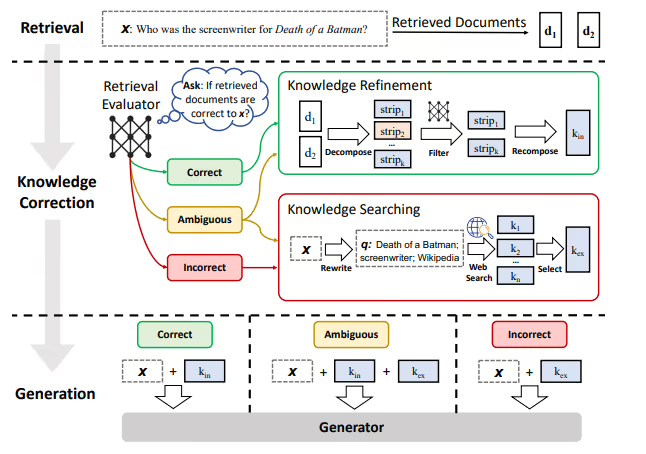
CRAG at Inference
CRAG at Inference (https://arxiv.org/abs/2401.15884)

Top Level Structure

CRAG has three main parts:

  1. Generative Model: It generates an initial sequence.
  2. Retrieval Model: It retrieves context based on the initial sequence from the knowledge base.
  3. Retrieval Evaluator: It manages the back-and-forth between the generator and retriever, ranks options, and decides the final sequence to be given as output.

In CRAG, the Retrieval Evaluator links the Retriever and Generator. It keeps track of the text created, asks the generator for more, gets knowledge with updated info, scores options for both text fit and accuracy, and chooses the best one to add to the output at each step.
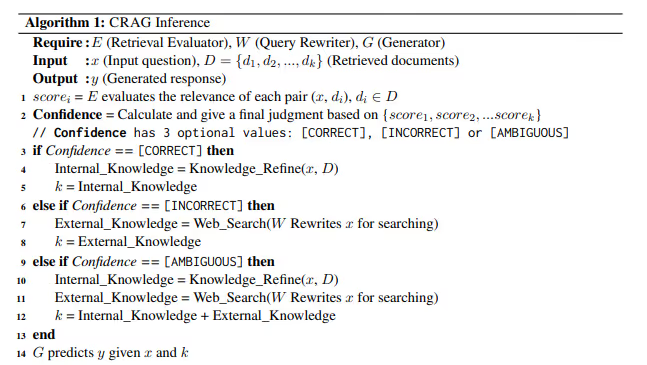
Pseudocode of CRAG
Pseudocode of CRAG from paper

Implementation

Here's the Colab notebook. Implementation will include giving ratings/scores to retrieved documents based on how well they answer a question:

For Correct documents -

  1. If at least one document is relevant, it moves on to creating text
  2. Before creating text, it cleans up the knowledge
  3. This breaks down the document into “knowledge strips”
  4. It rates each strip and gets rid of ones that don’t matter

For Ambiguous or Incorrect documents -

  1. If all documents need to be more relevant or are unsure, the method looks for more information.
  2. It uses a web search to add more details to what it found
  3. The diagram in the paper also shows that they might change the question to get better results.

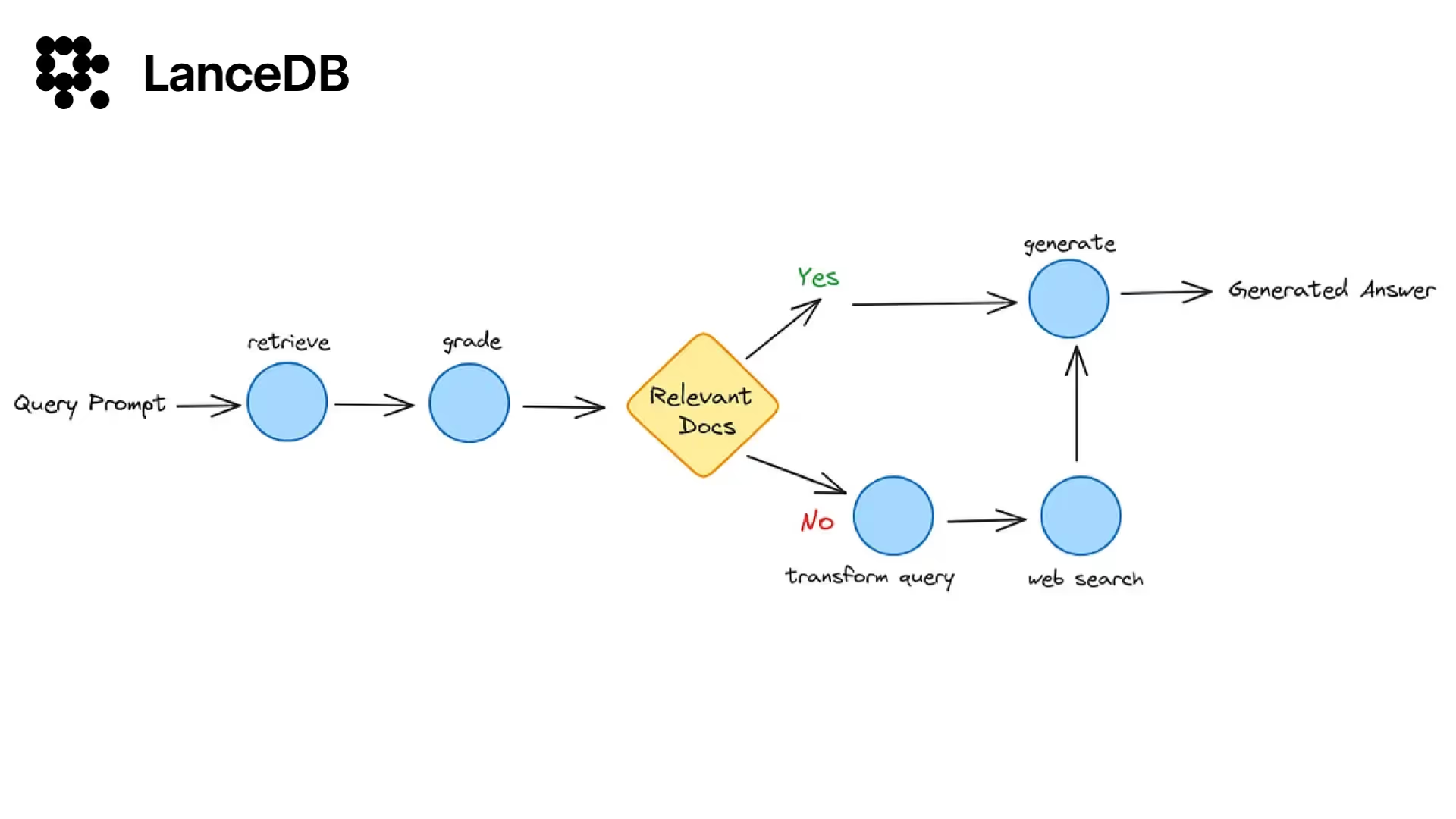
We will implement CRAG using Langgraph and LanceDB. LanceDB for lightning-fast retrieval from the knowledge base. Here is the flow of how it will work.
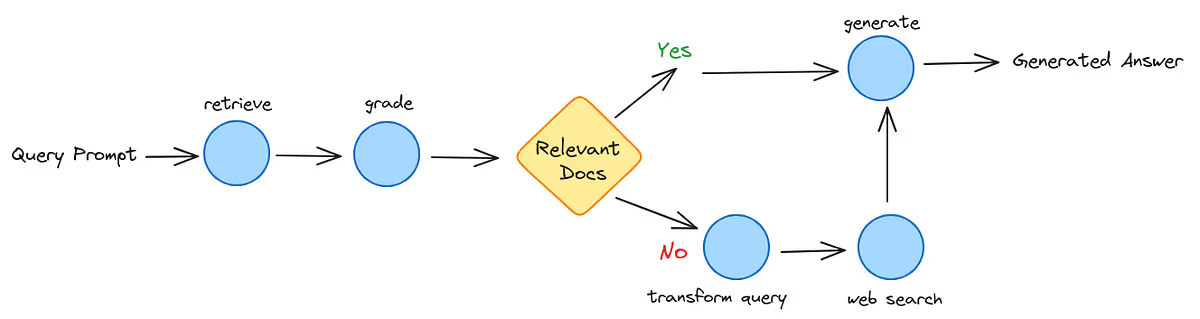
Flow diagram

The next step to implement this flow will be:

  1. Retrieve relevant documents
  2. If a relevant document is not found, go for supplement retrieval with a web search(using Tavily API).
  3. Query re-writing to optimize the query for web search.

Here is some pseudocode. For a complete implementation, please refer to the linked Colab notebook.

Building Retriever

from langchain.text_splitter import RecursiveCharacterTextSplitter
from langchain_community.document_loaders import WebBaseLoader
from langchain_community.vectorstores import LanceDB
from langchain_openai import ChatOpenAI, OpenAIEmbeddings

# Using Jay Alammar's articles on Transformers, BERT, and retrieval
urls = [
    "https://jalammar.github.io/illustrated-transformer/",
    "https://jalammar.github.io/illustrated-bert/",
    "https://jalammar.github.io/illustrated-retrieval-transformer/",
]

docs = [WebBaseLoader(url).load() for url in urls]
docs_list = [item for sublist in docs for item in sublist]

# document chunking
text_splitter = RecursiveCharacterTextSplitter.from_tiktoken_encoder(
    chunk_size=250, chunk_overlap=0
)
doc_splits = text_splitter.split_documents(docs_list)

Define knowledge base using LanceDB

import lancedb

def lanceDBConnection(embed):
    db = lancedb.connect("/tmp/lancedb")
    table = db.create_table(
        "crag_demo",
        data=[{"vector": embed.embed_query("Hello World"), "text": "Hello World"}],
        mode="overwrite",
    )
    return table

Embeddings Extraction

We will use the OpenAI embeddings function and insert them in the LanceDB knowledge base for fetching context to extract the embeddings of documents.

# OpenAI embeddings
embedder = OpenAIEmbeddings()

# LanceDB as vector store
table = lanceDBConnection(embedder)
vectorstore = LanceDB.from_documents(
    documents=doc_splits,
    embedding=embedder,
    connection=table,
)

# ready with our retriever
retriever = vectorstore.as_retriever()

Define Langgraph

We will define a graph for building Langgraph by adding nodes and edges as in the above flow diagram.

from typing import Dict, TypedDict

from langchain_core.messages import BaseMessage

class GraphState(TypedDict):
    """
    Represents the state of our graph.

    Attributes:
        keys: A dictionary where each key is a string.
    """

    keys: Dict[str, any]

This Graph will include five nodes: document retriever, generator, document grader, query transformer, and web search, and 1 edge will decide whether to generate or not.

The following graph shows the flow shown in the diagram.

import pprint

from langgraph.graph import END, StateGraph

workflow = StateGraph(GraphState)

# Define the nodes
workflow.add_node("retrieve", retrieve)  # retrieve docs
workflow.add_node("grade_documents", grade_documents)  # grade retrieved docs
workflow.add_node("generate", generate)  # generate answers
workflow.add_node("transform_query", transform_query)  # transform_query for web search
workflow.add_node("web_search", web_search)  # web search

# Build graph
workflow.set_entry_point("retrieve")
workflow.add_edge("retrieve", "grade_documents")
workflow.add_conditional_edges(
    "grade_documents",
    decide_to_generate,
    {
        "transform_query": "transform_query",
        "generate": "generate",
    },
)
workflow.add_edge("transform_query", "web_search")
workflow.add_edge("web_search", "generate")
workflow.add_edge("generate", END)

# Compile
app = workflow.compile()

# Run
query_prompt = "How Transformers work?"
inputs = {"keys": {"question": query_prompt}}
for output in app.stream(inputs):
    for key, value in output.items():
        # print full state at each node
        pprint.pprint(value["keys"], indent=2, width=80, depth=None)
    pprint.pprint("------------------------")

# Final generation
print("*"*5, " Generated Answer ", "*"*5)
pprint.pprint(value["keys"]["generation"])

Here is the generated answer output, illustrating each node’s functioning and their decisions, ultimately resulting in the final generated output.
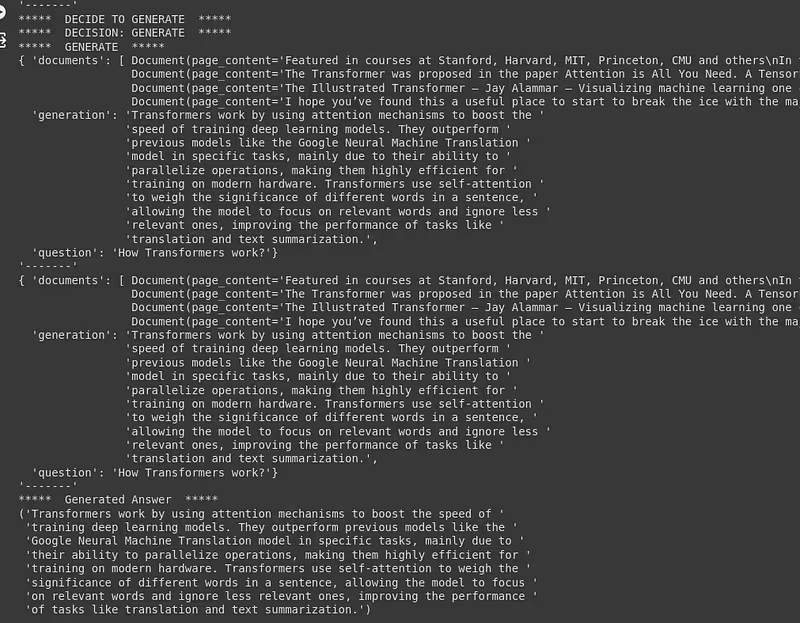
Output of implemented CRAG

Check out the Colab for implementation.

Challenges and Future Work

CRAG helps generate more accurate factual information out of the knowledge base, but still, Some Challenges remain for the widespread adoption of CRAG:

  1. Retrieval quality depends on comprehensive knowledge coverage in the knowledge base.
  2. Increased computation cost and latency compared to basic models.
  3. The framework is sensitive to retriever limitations.
  4. Balancing between fluency and factuality is challenging.

Stable-Worldmodel: A High Performance Platform for Reproducible World Model Research

Ayush Chaurasia
Quentin Lhoest
Lucas Maes
Quentin Le Lidec
June 2, 2026
stable-worldmodel-a-high-performance-platform-for-reproducible-world-model-research

🌍 Lance-Backed World Model Platform, 🦆 Multimodal SQL with Lance DuckDB Extension, 💰 LanceDB vs OpenSearch Cost Breakdown

ChanChan Mao
May 28, 2026
newsletter-may-2026

Reproducible Data Curation In The Multimodal Lakehouse

Prashanth Rao
May 29, 2026
reproducible-data-curation-in-the-multimodal-lakehouse