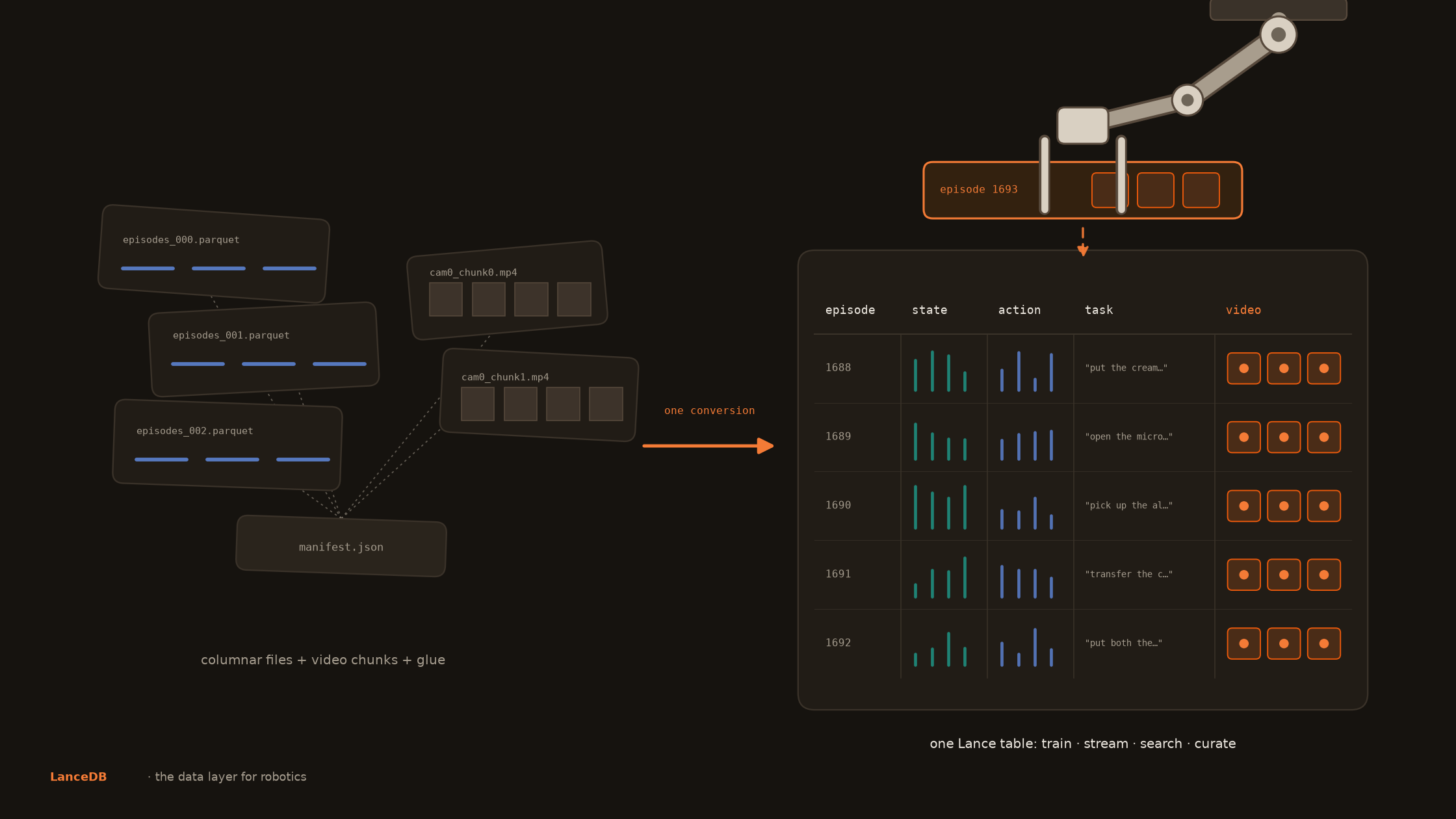
Every robotics stack stores the same things: camera streams plus a thin table of states, actions, and task strings. And almost every stack stores it across multiple systems glued together. LanceDB collapses them into one table that trains, streams, searches, and curates. This post is about robotics data in general, not any single framework. We use LeRobot, the field's open standard, as the worked example because it's the cleanest and most reproducible place to measure everything, from the dataloader to closed-loop eval.
State of robotics data
Robot learning data is videos with metadata table: a few camera streams, proprioceptive state, actions, task strings. Nearly every stack in the field uses this sturcture to store it: columnar files for the tabular columns, chunked mp4 files for pixels, with bookkeeping metadata holding them together. The [LeRobot v3 format](https://huggingface.co/docs/lerobot/lerobot-dataset-v3) is the canonical open version of that layout.
Video is the right container for camera streams. The glue is where training hurts. A shuffled VLA batch with a 50-step action chunk means seeking into mp4s and decoding GOPs, sample after sample. And nothing about parquet+mp4 can answer a question like *"show me every frame where the gripper is above the stove."*
[lerobot-lancedb](https://lancedb.github.io/lerobot-lancedb/) collapses the two systems into one: a Lance table for the tabular columns and a companion **blob ** table holding the *same mp4 bytes*. And because it's one table rather than a pile of files and manifests, the layout is an **enforced schema**, not a convention. Every episode a robot uploads either fits this contract or gets rejected at write time. There is no "the parquet says 214 frames but the mp4 has 212":
frames table — one row per frame            videos table — one row per episode × camera
─────────────────────────────────────       ─────────────────────────────────────────
episode_index      int64                    episode_index   int64
frame_index        int64                    camera          string
timestamp          float32                  video           large_binary
task               string                     └─ metadata: lance-encoding:blob=true
observation.state  fixed_size_list<float32>[8]
action             fixed_size_list<float32>[7]
emb_image          fixed_size_list<float32>[768]   ← added later, zero-copy
The dataset stays video-sized (1.9 GB for LIBERO's 273k frames), decoded pixels are bit-exact vs the source videos, and the format gives you what the glue can't: fast frame-level random access, S3 byte-range streaming, and secondary indexes on the same table. Everything below is measured on a 4×H100 box. Every script is in the [lancedb/training example](https://github.com/lancedb/training).
LanceDB dataloader for robotics
LanceDB's lerobot plugin is optimised for faster dataloading. It uses LanceDB's blob encoding to lazily seek requested frames from episodes without loading the entire file in memory.
The test: [ACT](https://huggingface.co/docs/lerobot/en/policies#act) (~50M params) on [DROID-100](https://huggingface.co/datasets/lerobot/droid_100) (3 cameras per frame). Identical 4×H100 trainings, same seed, same mp4 bytes. The only variables are the data layer and the CPU budget, pinned identically for both backends.
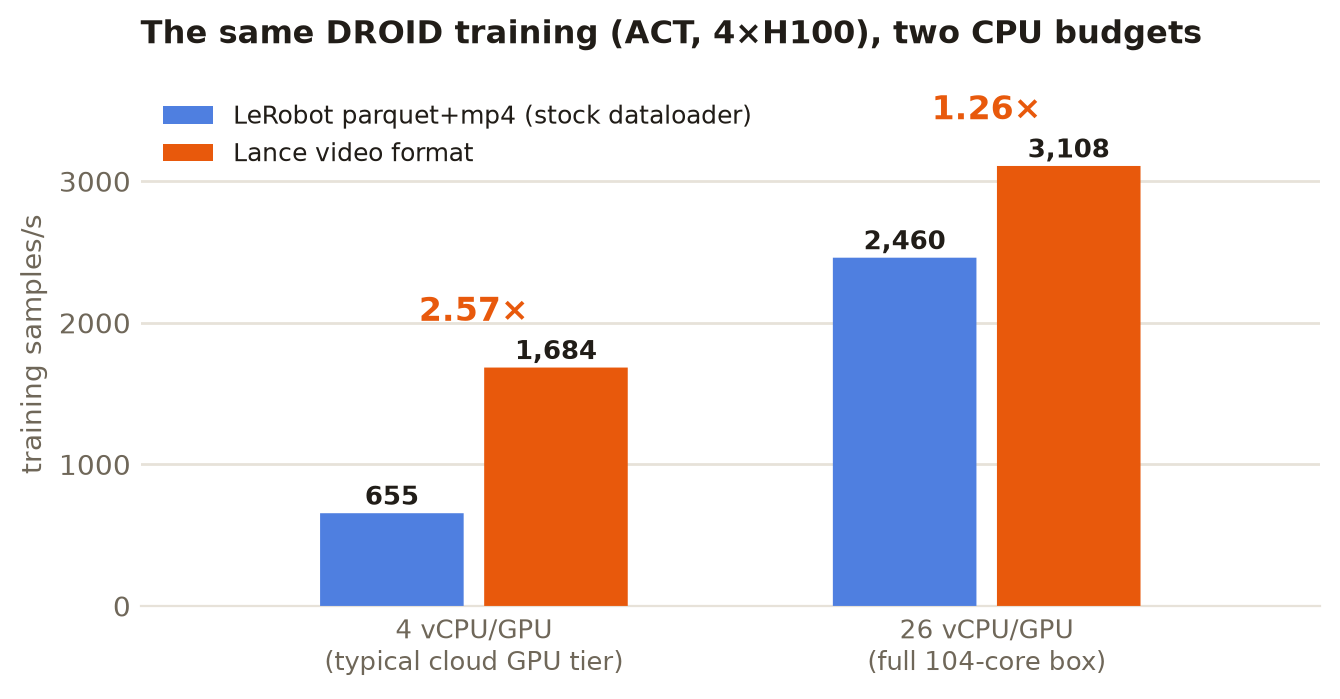
The full 20k-step wall clock at the 4 vCPU budget: 50m04s for Lance vs 1h55m37s for the baseline (2.31×) Loss curves match to the third decimal at every logged step. Same bytes, same model, same result. One of them just waits on its dataloader.
The gap depends on how dataloader-bound the run is. Give the run plenty of CPU and the loader hides. The faster your GPUs get, the bigger this gap gets. . LanceDB dataloader for lerobot can get upto 3-5x speedup or more when using enterprise. With efficient data loaders, your GPU spends less time waiting for data:

Here's a few examples evaluating models we trained
**"transfer the cube to the other arm", before vs after:**
Using LanceDB with Lerobot
You can use LanceDB dataloader by swapping out the base loader with a single line change
from lerobot_lancedb import LeRobotLanceVideoDataset

dataset = LeRobotLanceVideoDataset(
    "lerobot/droid_100", root="./droid100_lance",
    delta_timestamps=delta_timestamps,   # resolved from your policy config as usual
    return_uint8=True,
)
# everything downstream is unchanged: EpisodeAwareSampler, DataLoader, your train loop
Converting an existing dataset is one command
lerobot-convert-to-lance-video --repo-id=your/dataset --src-root=... --output=./ds_lance
Training a VLA: SmolVLA on LIBERO
Okay now lets look at the popular VLA class of models. We finetuned SmolVLA (450M, language-conditioned) on the LIBERO benchmark with both backends. Identical 40k-step recipes, task strings flowing through the language collate, evaluated closed-loop over all four suites, 100 episodes per suite per model. at 450M the GPU is the bottleneck and both formats keep it fed.
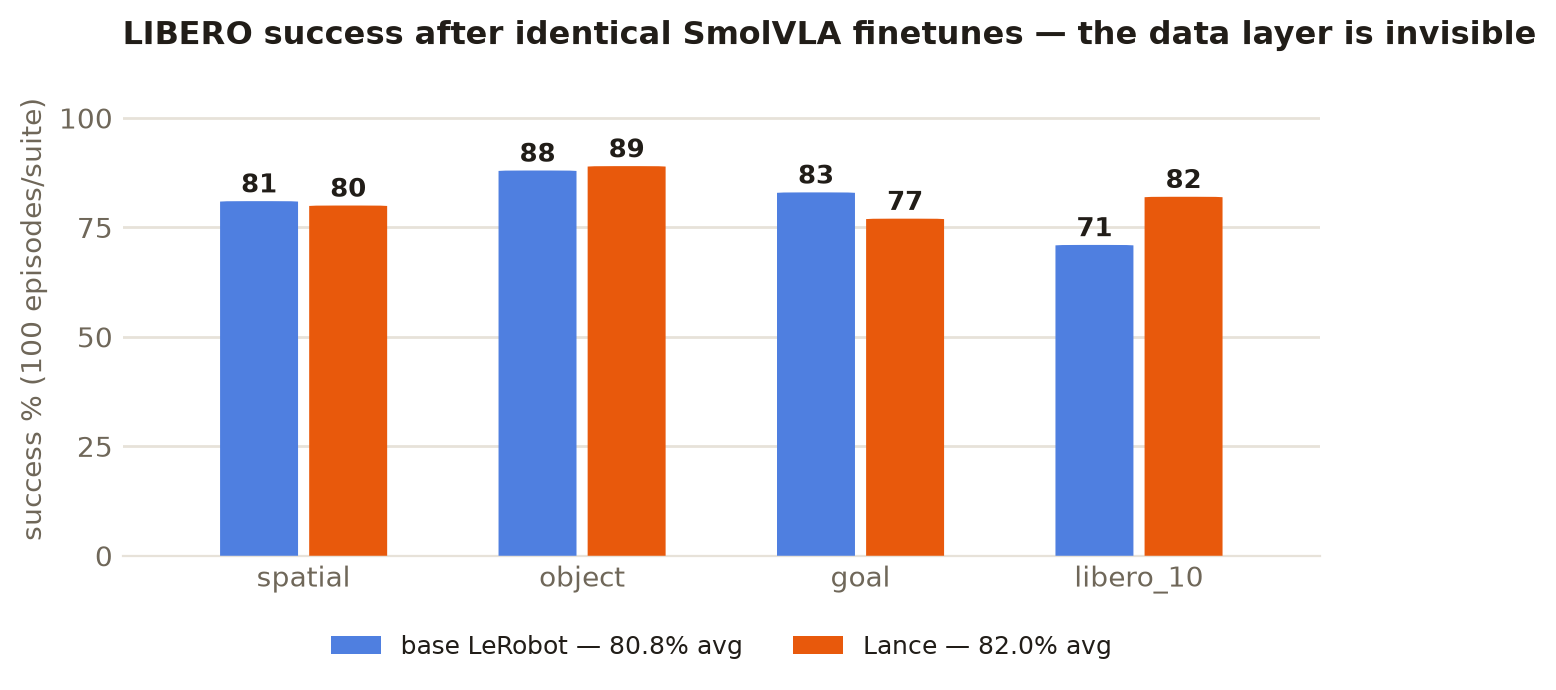
Here's every suite, same model before and after finetuning, side by side:
> One eval gotcha we hit so you don't have to: LeRobot's `--policy.n_action_steps` controls how much of SmolVLA's 50-step action chunk executes open-loop before re-planning, and it dominates measured success. The same checkpoint that scores 82% closed-loop scores 14.8% when it executes 10 steps per chunk (72% at 1 step, 1% at 25). If your LIBERO numbers look inexplicably bad, check this flag before blaming your model.
Training directly from remote object store
Base LeRobot has no remote object storage streaming path. You sync the dataset down, then train. The Lance reader takes an `s3://` URI directly and does byte-range reads against the blob column. No local copy ever gets created. With LanceDB, you get fast streaming from object storage so you can keep your GPUs fed without having to copy expensive data every ime you train. This is useful when your dataset grows from a few GBs to PBs. LanceDB also supports streaming gcs, azure and HF buckets.
| read pattern (8 workers) | parquet+mp4, local NVMe | Lance, streamed from S3 | Lance, local NVMe |
|---|---:|---:|---:|
| DROID (3 cams) | 722 | **897** | 1,709 |
| ALOHA sim | 817 | **1,013** | 2,296 |
| LIBERO (2 cams, SmolVLA pattern) | 1,271 | **1,445** | 3,111 |
That's samples per second with a same-region bucket, and time-to-first-batch is 10 to 15 seconds. At 16 workers the S3 numbers grow to 1,690 to 2,458 samples/s. That's enough to fully feed every training config above with the dataset never touching the machine.
There are several other advantages of using LanceDB as your data layer for robotics:
- no dataset volume at all - the GPU node needs disk for checkpoints, not data
- no sync step
- node boots, training starts, first batch in seconds. one copy shared by N nodes
- cheaper storage - bject storage runs roughly 3 to 4× cheaper per GB than the SSD volumes you'd otherwise sync to, and robotics corpora only grow
- Fine-tuning on curated set - because it can random-access over S3, a **curated slice** can train against a corpus that never fits on the node at all. You read the 50 GB you selected out of the 10 TB you own
## Add features and evolve your data for free!
LanceDB supports 0-copy data evolution, i.e, when add a new column /feature , it only writes the new data to the existing table and doesn't create copies of the original data. At large scale this process saves a lot of time and storage. Feature engineering is a critical piece for training good models. LanceDB's geneva allows you to run feature engineering jobs at scale on LanceDB tables, without creating expensive copies, messing with k8s / spark cluster configs or being gated on infra support. So as a researcher you only have to worry about defining the right features and not the infra to compute them at scale. Geneva takes care of distributing the jobs across workers, smart checkpointing etc.
### Backfill features with Geneva
We added a SigLIP2 embedding column with [Geneva](https://lancedb.com/docs/geneva/), LanceDB's feature engineering engine. The UDF is stateful (the model loads once per worker), batched (batches arrive as Arrow arrays), and GPU-scheduled.
@udf(data_type=pa.list_(pa.float32(), 768), num_gpus=1, input_columns=["index"])
class EmbedAgentview:                      # stateful: SigLIP2 loads once per worker
    def __call__(self, index: pa.Array) -> pa.Array:   # batched
        # decodes pixels straight from the Lance video blob table
        ...

tbl.add_columns({"emb_image": EmbedAgentview(lance_root)})
tbl.backfill("emb_image", concurrency=2)   # 273,465 frames ≈ 10 min on 2 GPUs
Two things worth noticing here. The UDF reads pixels from the *video blob column*, so the frames table never stores image bytes. And the write is zero-copy schema evolution: a commit that adds a column, with no rewrite of the video.
Curation: Index it, search it
"the microwave door is open" top hits across 273k frames

That's a text query against the frame embeddings, answered by the same table the DataLoader reads. With parquet+mp4 you'd need an embedding store, an index service, and a manifest pipeline to do this. Three systems that can drift out of sync with your training data.
Four more things the same table answers
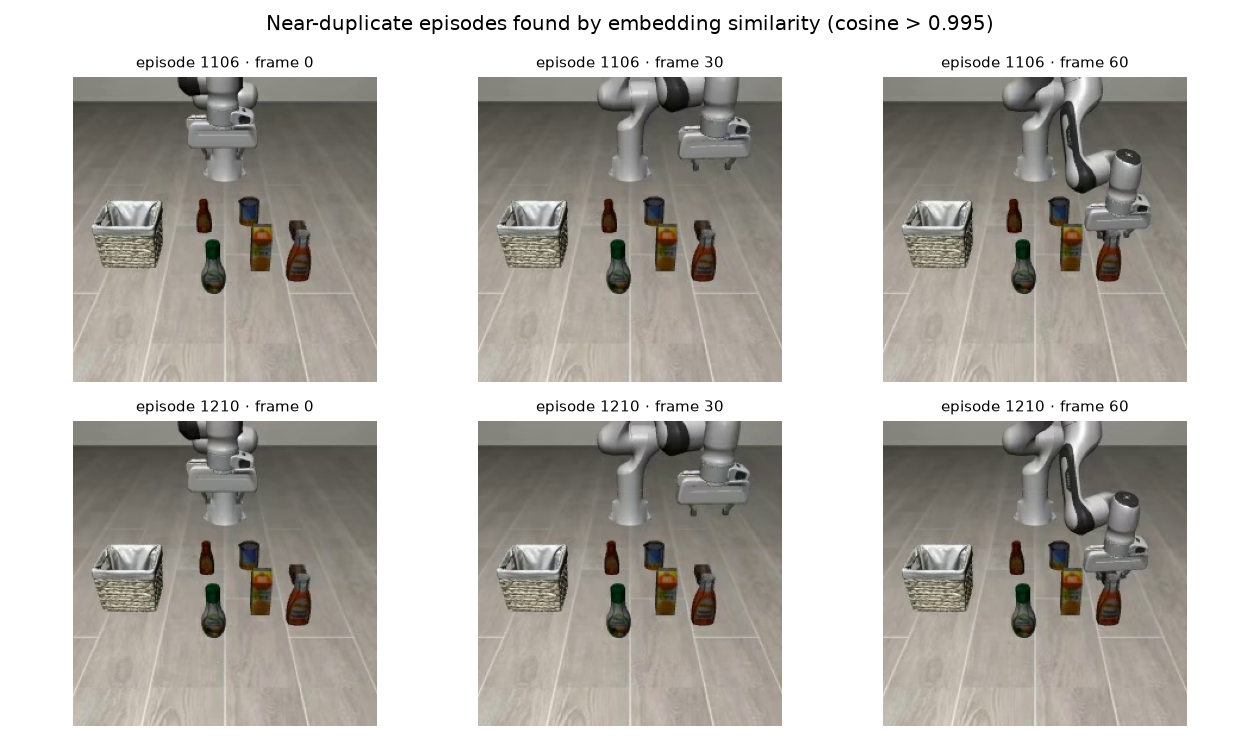
**Near-duplicate episodes.** Embed once, and redundancy pruning becomes a simple search problem. Comparing mid-episode frames across all 1,693 episodes at over 0.995 cosine similarity. Drop one before training.
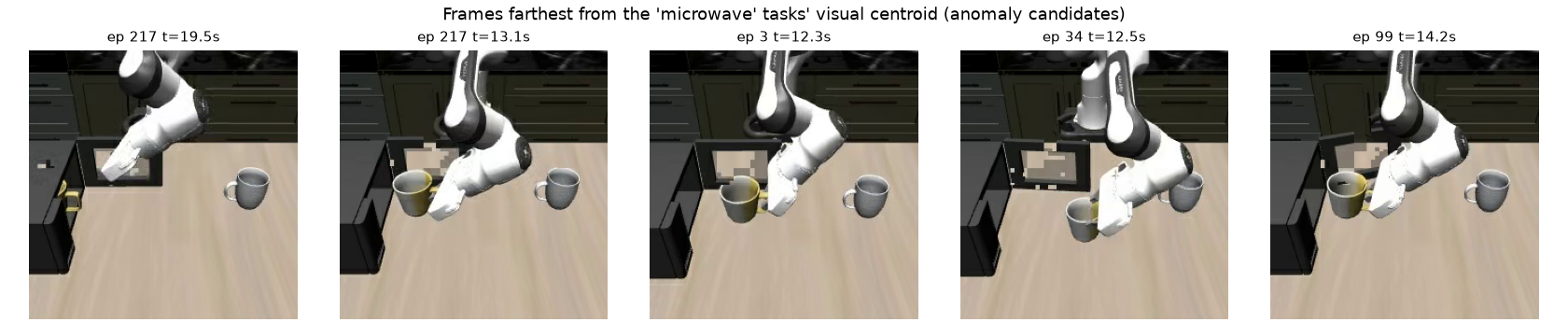
Outlier mining Within a task, the frames farthest from the task's visual centroid are your teleop glitches and camera-occlusion moments. Episode 217 shows up twice in the top-5 anomalies for the microwave tasks: the arm swallowing the lens. Exactly the frames to eyeball before they pollute a finetuning run.
Hybrid queries. Full-text and vector search compose. *"the gripper is holding the object in the air"* restricted to `task LIKE '%basket%'`. "Find me mid-grasp frames in basket tasks" becomes one call.
Time travel Every schema evolution and backfill committed a table version (this table has 26). You can open the exact tableversion a run trained on for reproducing it.
Training on the curated dataset
Curation only matters if it feeds back into training. Here a SQL filter on the task column becomes an episode list, and the episode list becomes a finetuning dataset.
eps = tbl.search().where(f"task IN ({object_tasks})") \
         .select(["episode_index"]).to_pandas()["episode_index"].unique()
# → 454 episodes, 66,984 frames; feed straight into --dataset.episodes
Now we run training directly from the source dataset filtering only the desired episodes. It went from 0% to **77% on its suite in 10k steps**, about 35 minutes of training. The 40-task generalist still wins the suite at 89%. At this scale, multi-task transfer beats a narrow finetune.

Efficiently store largevideo blobs with LanceDB's bolbv2
The video table stores each mp4's raw bytes in a `large_binary` column whose field metadata (`lance-encoding:blob=true`) turns on Lance's blob encoding. Values live in blob-oriented data files, the column materializes as lightweight (position, size) descriptors, and returns lazy file-like handles that support byte-range reads, locally or over S3. torchcodec decodes straight from those in-memory buffers. That's why conversion is instant, pixels are bit-exact, the dataset stays video-sized, and a shuffled DataLoader still gets frame-level random access.
The real world is 1000× bigger
Everything above ran on a 1.9 GB benchmark. That's small enough to measure cleanly, and small enough that almost any storage decision survives. A robotics program does not stay at 1.9 GB. A fleet of robots recording a few cameras each produces this dataset every few minutes. The corpora we've worked with in the wild, like VPT-scale video datasets and multi-terabyte teleop archives, sit three to four orders of magnitude above this example. That's where the two-system layout really breaks down:
- Ingestion becomes continuous, not a one-time conversion Thousands of robots and sim workers appending episodes at the same time need atomic, conflict-free writes into one namespace, not a directory of parquet shards and a manifest that two writers race to update. Lance commits are atomic and versioned, and the schema contract from the intro is enforced on every write, so a fleet can't silently upload malformed episodes.
- Syncing the dataset to the node stops being a small startup delay step and becomes an expensive op. Fast streaming dataloader is the way out: one copy in object storage, and every trainer streams byte ranges of exactly the slice it needs.
- Curation stops being optional. At 273k frames you can eyeball your data. At 200M+ frames, the only way to find duplicates, teleop glitches, or the 50 GB actually worth training on is the machinery above (embeddings, indexes, SQL over the same table), running as distributed jobs instead of a notebook.
- A 10-minute, 2-GPU backfill becomes a thousand-GPU-hour job. It will be preempted, it will hit bad rows, and it has to resume. That's exactly why Geneva backfills are checkpointed and distributed rather than a for-loop.
- Lineage becomes a compliance question. When a policy misbehaves on a real robot, "which table version, which episode list, which checkpoint" has to be answerable months later. Table versions and versioned splits scale with the table. Manifest files and tribal knowledge don't.
This is the workload [LanceDB Enterprise](https://lancedb.com/) runs for production AI teams: the same open Lance format underneath, plus the operational layer this scale demands. High-throughput distributed ingestion into object storage. Automatic compaction and index maintenance as the corpus grows. Geneva feature backfills scheduled across GPU fleets. Petabyte-scale scan throughput to keep multi-node trainings fed. And SLA-backed serving of the same tables for search and curation. The worked example above is the whole system in miniature. Enterprise is what it looks like when the fleet, not the benchmark, sets the scale.
## Conclu