The most important evidence shouldn’t be the last thing investigators find. They need to identify relevant evidence across vast collections without losing the context connecting individual records. In a million-document investigation, a crucial email discovered late can change the direction of months of work. Traditional search and distributed manual review make that work slow and difficult to coordinate. Augmetec, an AI-powered platform for internal and regulatory investigations, needed a data foundation that could combine precise search criteria with semantic relevance and grow with increasingly large investigations.
Why LanceDB Enterprise?
- Combines vector search, full-text search, and metadata pre-filtering in one query, so investigators can express meaning and exact criteria together.
- Pre-filters on metadata before search rather than after, which keeps recall intact when a filter narrows a million-document corpus to a few thousand.
- Provides a SQL endpoint for structured analysis over the same data.
- Separates query serving from background indexing and maintenance, allowing serving capacity and background processing to grow independently.
- Uses caching to accelerate repeated searches over evidence in object storage, with query-serving capacity that can grow as investigator demand increases.
- Keeps persistent investigative data in Augmetec-owned storage while LanceDB manages the database service.
Outcomes at a glance
- Faster work, greater capacity. Up to six months → minutes to identify and prioritize the documents and communications most relevant to a Line of Enquiry, surfacing first results in under 5 seconds, helping teams take on more client work.
- Fewer reviewers, same coverage. Large cases can run 2-5M documents, emails and contracts. LEIAA reduces the human hours required by more than 70%. Same coverage takes a fraction of the people and hours, with investigators still validating the results.
- More accurate, consistent review. Investigators assess related evidence in context instead of splitting a corpus into portions reviewed separately and passed upward.
- Better investigations. Combine meaning and intent with exact criteria, then refine the line of inquiry as evidence emerges.
- Proven in production. Over 1M documents and 100M vectors per job
- Designed for scale. Architecture supports tens of millions of documents and over a billion vectors
- Fast time to insights. Minutes after files reach LEIAA → high-risk documents start surfacing. A 50k-document case is fully indexed within an hour; a 1M-document case within 24 hours.
When evidence is divided, context can disappear
A corporate investigation can begin with a single allegation and quickly expand into millions of records. An email may raise a question that an invoice answers. A conversation may take on a different meaning when viewed alongside witness testimony. Finding those connections requires investigators to understand the evidence as a whole.
Augmetec’s CEO, Kritin Sundaram, has seen how difficult that becomes when review is distributed across large teams. In his work previously as a litigator, he saw first hand how investigations involving two or three million pieces of data required 20-30 paralegals. Each reviewer sees an assigned portion, then passes findings to a senior investigator. Context can be lost both within those separate reviews and as knowledge moves between people. That’s important context that could change a case.
Search adds another challenge. Investigators must anticipate which words will reveal the relevant evidence. A narrowly worded search can miss a conversation that expresses the same idea with different words but carries the same meaning.
Augmetec set out to give investigators a more flexible way to explore the evidence; one that keeps precise search controls while also searching for the meaning behind the words.
Choosing a foundation for investigative retrieval
Augmetec needed more than a database that returned a few relevant passages. Its investigators need to find the documents that matter, read them in full, and understand why other material is excluded.
That requirement shaped its selection of LanceDB. Jonny Jackson, Augmetec’s CSO, valued its disk- and object-storage-based architecture for the company’s scale ambitions, and its expressive query interface for multiple vectors, metadata pre-filtering, and more sophisticated retrieval routines. He also valued the opportunity to work directly with LanceDB’s engineers as Augmetec developed its approach.
“We chose LanceDB Enterprise for the combination of scale and expressive querying. It gives us the building blocks to develop increasingly sophisticated retrieval as the volume of evidence grows.”
- Jonny Jackson, CSO, Augmetec
Where LanceDB fits inside LEIAA
LanceDB Enterprise underpins the data inquiry layer of LEIAA, Augmetec’s investigation platform. Augmetec supplies the ingestion, enrichment, investigative workflow, and document-ranking logic; Enterprise supplies the managed data and retrieval service those capabilities use.
The flow has five main steps:
- Collect and prepare evidence. Source files reside in Google Cloud Storage. Augmetec’s ingestion services create document records and metadata, then additional processing produces searchable chunks and other representations.
- Store connected representations. LanceDB holds document information and searchable fragments, including text, embeddings, and identifiers linking fragments back to their parent documents.
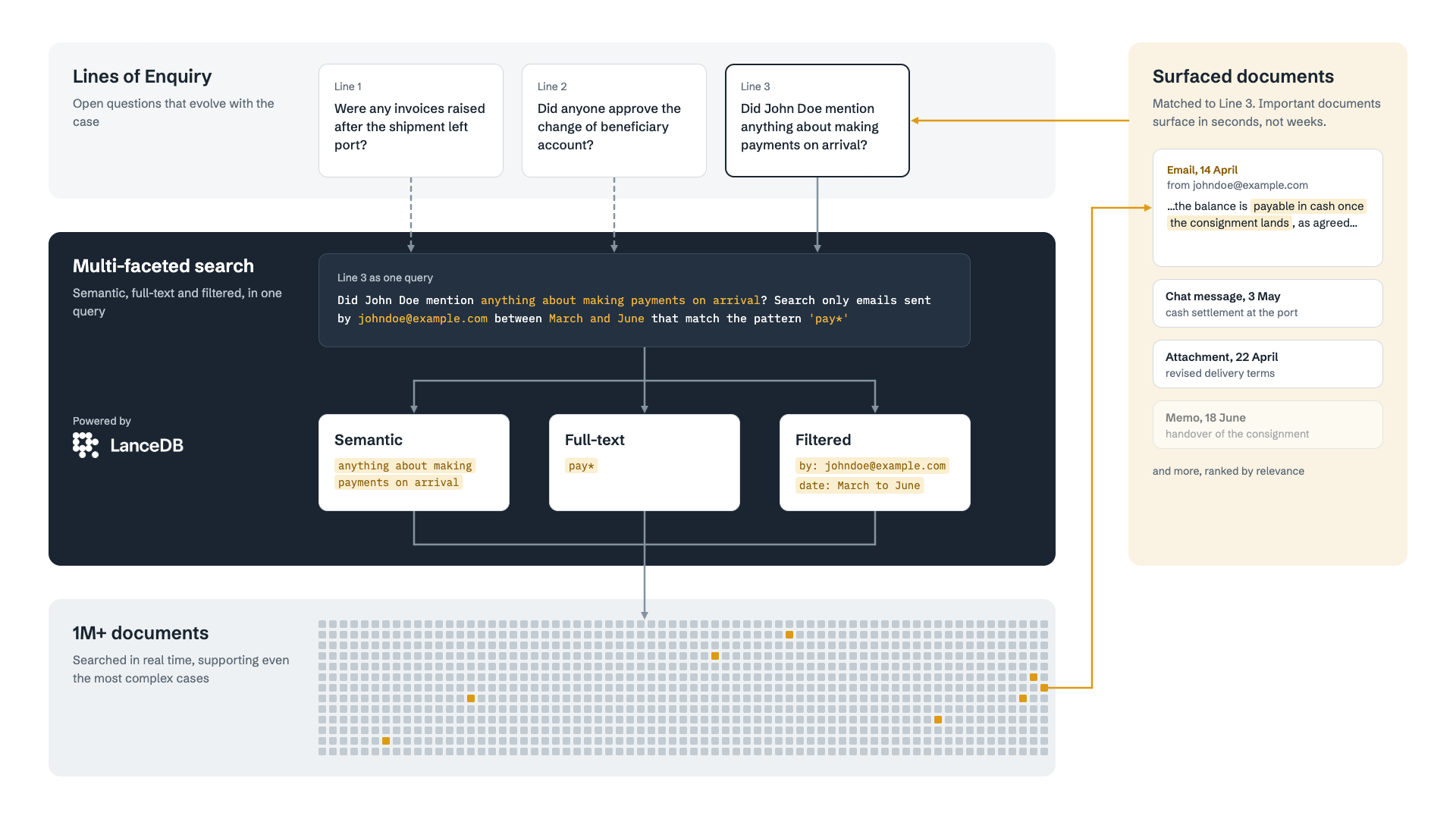
- Retrieve and rank. LEIAA uses semantic and lexical retrieval with filters. Its ranking approach combines evidence from individual matches into document-level relevance, enabling investigators to find and read the underlying source documents.
- Continue the investigation. Investigators refine their questions and assess the results. Augmetec’s workflow tracks review decisions, while its separate observability and audit systems account for processing outcomes.
- Absorb new evidence mid-matter. As additional productions and custodians are added, Augmetec's ingestion services process the new material and LanceDB indexes it alongside what's already there. Investigators keep working while the collection grows, and searches run against the current state of the evidence rather than a snapshot from the last rebuild.
Finding meaning while preserving investigative rigor
An investigation may need to find communications involving a particular person and a possible improper payment. Name matching alone, exact or fuzzy, only surfaces records that use the words investigators thought to search for. Semantic retrieval can surface communications that refer to a bribe, an incentive, or other expressions of the same underlying concept, even if those exact words are never used.
That changes the kinds of questions investigators can explore. They can test an initial hypothesis, examine the evidence it surfaces, and follow a new line of inquiry when the results challenge their assumptions. LanceDB supplies retrieval capabilities; Augmetec turns those capabilities into an investigative experience grounded in source material.
In effect, LEIAA works as a ranking engine across the whole collection. The goal is to bring the most important evidence forward early while preserving the thoroughness of the review. Relevant documents still need to be read; excluded material needs a reason that can be traced.
This approach supports Augmetec’s aim of greater accuracy and consistency. Investigators assess related evidence in context and apply a common line of inquiry across the collection.
Turning faster analysis into capacity for more clients
For Augmetec, the business opportunity is simple: give investigators back their time to spend interpreting evidence, conducting interviews, and developing findings, rather than searching for them.
Instead of devoting months to clicking through documents, investigators can interrogate massive evidence collections and get relevant results in seconds. That shifts their time from searching for information to following lines of inquiry, testing hypotheses, and building stronger cases.
"With LanceDB, we can give investigators more capacity and help them understand the evidence more thoroughly. They spend more time applying their expertise, and they can take on work they previously had no room for."
- Kritin Sundaram, CEO, Augmetec
Building for the next generation of investigations
Augmetec is designing for evidence collections that extend well beyond an individual reviewer’s capacity. LanceDB is central to a workflow built to handle tens of millions of documents and over a billion vectors per job. As those collections grow, LEIAA needs to support repeated, interactive searches while additional evidence is processed and indexed. New evidence becomes searchable as it is processed, without rebuilding indexes over material already in the collection.
Enterprise provides a path to increase query-serving capacity as more investigators and matters use LEIAA. Its query-serving resources can scale separately from background indexing and maintenance, while cached reads help repeated searches avoid fetching the same data from object storage. This is how Augmetec scales LEIAA without sacrificing the experience: investigators can keep refining questions and exploring evidence interactively as the volume of searchable material grows.
Investigators reach important evidence sooner, preserve the context that makes it meaningful, and have more time and capacity to pursue the next question.