
About This Talk
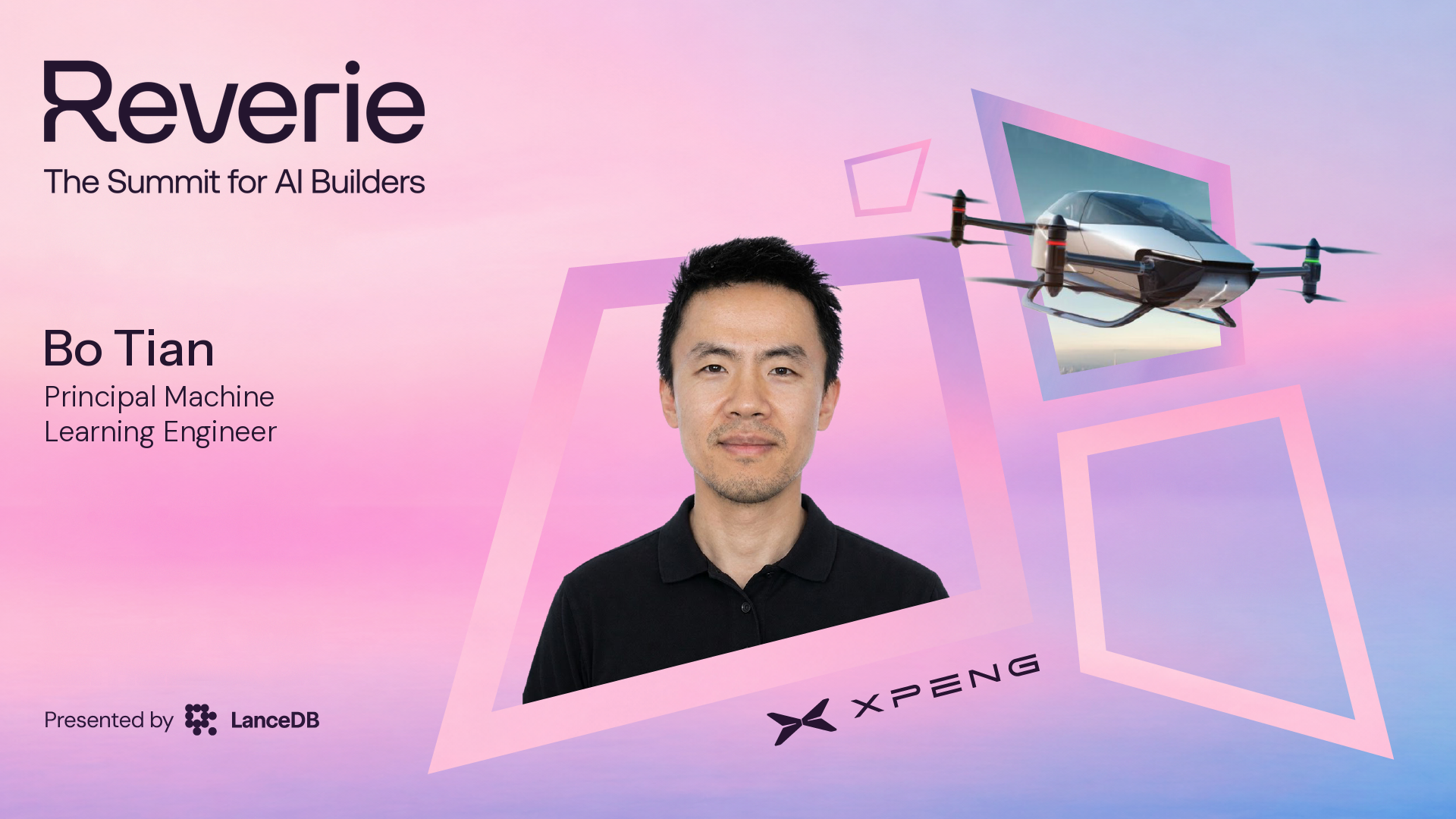
XPENG's VLA 2.0 (Vision-Language-Action) system learns to drive from an enormous, constantly growing corpus of multimodal data, including multi-camera video, sensor streams, and the language annotations that tie perception to action.
In this talk, Bo Tian will share how XPENG rebuilt its data infrastructure to serve as the foundation for VLA 2.0 training. The session will cover three shifts. First, training reads directly from Lance datasets on object storage, with random access fast enough that to no longer need to stage data onto a parallel file system before each job. Second, Lance's versioning and schema evolution to let annotation, curation, and feature teams add columns and iterate on datasets without rewriting the underlying video, so data iteration keeps pace with model iteration. Third, Lance's built-in vector search supports data mining, with embeddings alongside the raw clips, so engineers can find rare and long-tail scenarios with similarity queries across billion-scale clips and feed them straight into training sets.
The talk will close with lessons learned from running Lance at production scale in an autonomous-driving setting, and how XPENG sees the format evolving for embodied AI and robotics workloads.